
A World of Jewelry Traditions No. 7 Thailand
32 min reading time
32 min reading time
Thailand’s jewelry traditions remain remarkably alive. From the royal goldwork of Ayutthaya and Bangkok’s bustling jewelry markets to Chiang Mai’s northern silver, Chanthaburi’s gemstone expertise, the distinctive adornment of northern highland communities, and southern Thailand’s dramatic nielloware, craftsmanship is still visible in workshops, markets, and family businesses. Thailand reveals that jewelry traditions survive not simply because historic objects are preserved, but because artisans continue to practice, adapt, teach, and reinvent the skills behind them.
Where Craftsmanship Is Still a Way of Life
 Across Thailand, centuries-old jewelry traditions remain visible in workshops, markets, artisan communities, and the hands of contemporary makers.
Thailand's jewelry traditions remain remarkably alive. From the royal goldwork of Ayutthaya and Bangkok's bustling jewelry markets to Chiang Mai's northern silver, Chanthaburi's gemstone expertise, the distinctive adornment of northern highland communities, and southern Thailand's dramatic nielloware, craftsmanship is still visible in workshops, markets, and family businesses. Thailand reveals that jewelry traditions survive not simply because historic objects are preserved, but because artisans continue to practice, adapt, teach, and reinvent the skills behind them.
From Royal Gold and Northern Silver to Family Workshops and Living Traditions
The first thing many people notice when they enter one of Thailand's jewelry markets, especially in Bangkok, is the sparkle, and then they're hit with the bold colors.
Gold catches the light from every direction. Rubies and sapphires glow beneath display lamps. Silver fills trays and cases as shoppers weave between gemstone dealers, jewelry merchants, and small workshops. Patient attendants are constantly polishing those metals to achieve that sustained shine.
What stays with you, what you really notice, at least for me, is the rhythm of craftsmanship. An artisan quietly shaping silver with a small hammer. A jeweler studying a gemstone beneath a loupe. Someone polishing a finished piece only a few feet from where it will eventually be sold. Families working together, their conversations constantly shifting between craftsmanship and commerce.

Thailand's jewelry story is remarkable because it is not confined to museums or archaeological collections. It is still unfolding every day.
Across the country, royal traditions, Buddhist beliefs, regional identities, Indigenous cultures, international trade, and family craftsmanship continue to influence the jewelry being made today. Ancient techniques remain relevant not because they have simply been preserved, but because artisans continue to practice, adapt, and pass them from one generation to the next.
Thailand is also one of the world's important centers for gemstones and jewelry production. Bangkok and Chanthaburi have long connected miners, cutters, dealers, designers, craftspeople, and international buyers. Yet beyond this global industry lies another Thailand, one of local silversmiths, family workshops, regional techniques, and jewelry whose meaning is inseparable from the communities that make and wear it.
This living connection between history and contemporary craftsmanship is what makes Thailand's jewelry traditions so compelling.
Gold, sterling and high-content silver, rubies, sapphires, niello, jade, pearls and other gemstones
Hand forging, repoussé, chasing, engraving, niello, gemstone cutting and setting, filigree
Buddhism, Sukhothai and Ayutthaya kingdoms, Lanna culture, Khmer influence, Chinese and Indian trade, Indigenous highland cultures, maritime exchange
Bangkok, Ayutthaya, Chiang Mai and the Lanna North, Northern Highlands, Chanthaburi and the Eastern gem region, Southern Thailand
Historic techniques sustained through working artisan communities while Thailand continues to evolve as an international center for gems and jewelry

Thailand's jewelry traditions reveal very different stories: from royal gold and northern silver to gemstone markets and the distinctive metalwork of the south.
While every artisan and community has its own distinctive style, these characteristics provide a helpful starting point for recognizing Thailand's remarkably varied jewelry traditions.
Gold, silver, rubies, sapphires and other gemstones. Gemstone setting, goldsmith and contemporary fabrication. Traditional craftsmanship, family workshops and international design meet.
Gold, precious stones. Repoussé, chasing, granulation and fine goldwork. Lotus, floral scrolls, mythical and royal imagery reflecting the wealth of the historic Siamese capital.
Silver. Hammering, repoussé, chasing and engraving. Flowers, foliage, animals, Buddhist and geometric forms shaped by Lanna culture.
Silver, beads, coins and other materials varying by community. Forging, repoussé, engraving, beadwork. Expresses cultural identity, family wealth, ceremony and belonging.
Rubies, sapphires and colored gemstones. Cutting, heat treatment, grading and trading. A historic gem center connecting local knowledge with international markets.
Silver, gold and niello. Dense floral scrolls, vines and geometric ornament. Dramatic contrast between dark niello and polished metal.
Thai jewelry often rewards a second glance. Look for graceful curves, intricate surface designs, including lotus blossoms and flowing vines, Buddhist imagery and forms inspired by the natural world. In northern Thailand, silver frequently takes center stage. In the south, the black surface of niello creates dramatic contrast against polished silver or gold. In Bangkok and Chanthaburi, color may come instead from Thailand's extraordinary gemstone tradition. But perhaps the most important thing to look for is not a motif at all.
Look for evidence of the maker.
A slightly irregular hammered surface. A hand-worked pattern. The extraordinary precision of a stone setter. The tiny decisions that distinguish an object made with experience from one simply manufactured to imitate the appearance of handcraft.
In Thailand, understanding the finished piece often begins with understanding the person who made it. That attention to detail is a signature in its own right.
Gold, Royalty and a Cosmopolitan Kingdom
 Long before Bangkok became Thailand's center of commerce, Ayutthaya was one of Asia's great cosmopolitan capitals.
Founded in 1351, the Kingdom of Ayutthaya became wealthy through international trade. Merchants and diplomats arrived from China, Japan, Persia, India and eventually Europe. Precious materials flowed through the kingdom, and royal patronage supported sophisticated metalworking.
Gold held particular importance. Royal jewelry, ceremonial objects and Buddhist offerings displayed remarkable technical skill. Goldsmiths employed repoussé, chasing, granulation, gemstone setting and other methods to create intricately worked surfaces and forms.
Some of the most extraordinary evidence of Ayutthaya's goldworking heritage survived because it was hidden within Buddhist monuments, only to be rediscovered centuries later. Yet the importance of this jewelry extends beyond its material value.
Royal gold communicated power, devotion and the prosperity of a kingdom positioned at the center of international exchange. The craftsmanship also reminds us that Thailand's later role in global jewelry trade did not appear suddenly. Long before modern gem markets existed, Siam was already connected to international networks through which materials, techniques and artistic ideas moved.
Ayutthaya gives us Thailand's historical foundation. Bangkok shows us what happened next.
Where Jewelry Is Still Being Made in Plain Sight

Bangkok is now one of Asia's most important jewelry centers.
Gold merchants, gemstone dealers, cutters, designers, manufacturers, independent craftspeople and family businesses operate within an ecosystem that stretches from small market stalls to international jewelry companies.
For a visitor interested in jewelry, however, one of Bangkok's greatest pleasures is simply being able to see the industry working.
The boundaries between making, trading and selling can feel remarkably porous. A display of finished jewelry may sit near someone repairing a piece. Loose gemstones move from dealer to dealer. Craftspeople polish, solder and set stones while conversations with customers happen around them.
Jewelry is not just an elusive luxury object that somehow arrives perfectly finished in a glass case. You can see the process behind it, starting with the selection of the materials to the polishing of the final piece.
I have spent many hours wandering through Bangkok's gem and jewelry markets, and what continues to fascinate me is not simply the quantity of jewelry or gemstones. It is how visible the entire ecosystem remains.
Inside Bangkok's gemstone markets, where rough material, cut stones and finished jewelry coexist within the same trading ecosystem. Video: Sundara Joon.
You encounter people examining stones, artisans working only steps away from merchants, trays filled with materials waiting to become something else, and family businesses where knowledge has clearly accumulated over years. Those experiences change how you look at jewelry.
Once you have watched someone concentrate over a workbench or examined the extraordinary variety of stones before they are transformed into finished pieces, it becomes harder to see jewelry simply as a product. You begin to see the decisions, skill and human effort behind it.

Chatuchak Market, Bangkok
 Gemstone Stud Earrings
Suggested caption: Inside Bangkok's jewelry markets, the journey from material to finished piece remains remarkably visible.
Following the Gemstone
Thailand's jewelry story cannot be told through metalwork alone. Gemstones are fundamental to it.
Chanthaburi, in eastern Thailand, became particularly associated with rubies and sapphires. Although local deposits are no longer the source they once were, generations of expertise in sorting, cutting, treating and trading colored stones helped the city remain an important gem center.
All of this introduces another kind of craftsmanship. A gemstone does not emerge from the earth looking like the jewel we eventually see in a ring or necklace. Someone must understand where to cut it, how to orient the color, what inclusions can be accommodated, and how much material can be sacrificed to reveal the stone's greatest beauty.
Thailand also became particularly important in the development and refinement of heat treatment for corundum, the mineral family that includes ruby and sapphire. Treatment itself is not inherently problematic; the important issue for a buyer is transparency about what has been done to a stone.
Chanthaburi therefore asks us to expand our definition of the artisan. Sometimes the craftsperson shaping the final appearance of jewelry is not the goldsmith. It is the person who understands the stone.

Silver as a Regional Language
Northern Thailand tells a very different story from Ayutthaya's royal gold.
For centuries, Chiang Mai was the center of the Lanna Kingdom, whose cultural traditions developed through relationships with neighboring areas of what are now Myanmar, Laos and southern China.

Wat in Chiang Mai
Silver became an important medium. Bowls, ceremonial objects, household items and personal adornment could all become surfaces for elaborate repoussé, chasing and engraved decoration. Floral forms, animals, Buddhist imagery and geometric patterns transformed metal into narrative.
Today, silverwork remains visible in and around Chiang Mai, particularly in communities historically associated with the craft.

Detailed repoussé - bracelet example.
Look closely and the appeal is not simply the shine of the silver. It is the surface. The hammer marks create depth, and let the raised forms catch light differently from recessed areas. Oxidation can emphasize a pattern rather than conceal age. The object invites touch as much as gaze. This is craftsmanship experienced through texture.
Many Communities, Not One "Hill Tribe Style"

Akha tribe with adornment worn as part of dress

Hmong design jewelry
Travel markets often use the phrase "hill tribe silver" as though it describes a single jewelry tradition. It does not.
Northern Thailand is home to culturally distinct communities including Karen, Hmong, Akha, Lahu, Lisu and Iu Mien peoples, among others. Each has its own language, history, clothing, customs and traditions of adornment. Silver can often carry meanings extending far beyond decoration.
Depending on the community and object, jewelry may communicate family wealth, marital status, age, protection, ceremonial significance or belonging. Coins, beads, bells, chains, repoussé elements, neck rings and other forms can become part of elaborate traditional dress.
Understanding these distinctions matters. When diverse communities are reduced to the single commercial label "tribal," much of what makes their jewelry meaningful disappears. We say tribal because it's a term people generally understand when searching, but if we know definitively the tribe and more detail we will add that information.
Authentic Northern Thai Hill Tribe Jewelry: Handmade Silver Bracelets, Necklaces & Earrings
The Drama of Niello

Traditional Thai nielloware, notice the black-and-silver surface in close detail.
Southern Thailand introduces yet another visual language.
Niello creates an immediately recognizable contrast. Engraved or incised patterns in metal are filled with a dark metallic compound, creating black decoration against silver or gold. The result can be extraordinarily dramatic.
Floral scrolls and complex patterns emerge almost like drawings across the metal surface. The contrast makes even small details highly visible.
Nakhon Si Thammarat became particularly celebrated for Thai nielloware, a tradition historically associated with fine presentation objects and royal patronage as well as personal adornment.
The technique also reminds us of southern Thailand's position within much larger maritime networks. For centuries, the Malay Peninsula connected communities trading across the Indian Ocean and South China Sea. Artistic traditions moved alongside spices, textiles, metals and people.
Once again, geography becomes visible in craftsmanship.
What the Finished Piece Doesn't Show You
Metal must be cut. Heated. Hammered. Bent. Soldered. Filed. Polished.
A gemstone must be studied before it is cut. A setting must hold a stone securely without overwhelming it. A repeated pattern that appears effortless may represent thousands of movements practiced over many years.
The finished object conceals most of this labor. That is part of its magic. But understanding the process allows us to appreciate something that price, weight and gemstone size cannot measure easily: skill.
In Thailand, where the distance between workshop and marketplace can still be remarkably small, visitors have an unusual opportunity to witness that skill directly. If you ever get the opportunity, I encourage you to take it. Its not often you get such an up close and personal encounter.

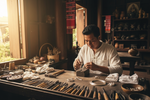
A workshop where some of the magic happens
Royal gold from Ayutthaya looks very different from northern silver. A ruby passing through Chanthaburi can seem far removed from a niello ornament made in southern Thailand. And the jewelry of an Akha community should never be treated as interchangeable with the adornment of a Karen or Hmong community. Yet several themes connect Thailand's jewelry story.
The process of making has not disappeared completely behind industrial production.
Northern mountains, eastern gemstone regions, southern maritime routes and historic capitals produced different materials, techniques and traditions.
Thailand has absorbed influences for centuries while developing its own artistic vocabulary.
Whether royal, religious, Indigenous, commercial or familial, jewelry often exists within relationships between people.
Today's Thai artisans do not simply reproduce the past. They reinterpret techniques, combine materials and create jewelry for contemporary lives. That evolution is often how tradition survives.

One Artist, So Many Interpretations. What Will He Pass On To His Daughter?
Throughout A World of Jewelry Traditions, I've asked you to look at jewelry a little differently each time.
At the maker.
And what happens to a jewelry tradition when that chain of knowledge is broken?
A museum can preserve an extraordinary object. Only people can preserve the knowledge required to make another one. That may be the most important lesson Thailand offered me and I share with you.
One of the great privileges of discovering jewelry in Thailand is seeing how closely craftsmanship remains connected to everyday life. In the markets, workshops and family businesses, each reveal something that cannot always be understood by looking at a finished piece in isolation. Behind it is a person.
At Sundara Joon, experiences like these have shaped the way we think about jewelry and the makers we seek out. The pieces that stay with us are rarely memorable because they contain the largest gemstone or the greatest amount of precious metal.
They stay with us because someone made a choice, such as an unexpected combination of materials, a slightly unusual shape, or a traditional technique used in an entirely new way. A piece that carries the unmistakable evidence of an individual imagination, that is what we love and want to share.
Thailand reminds us that craftsmanship survives when artisans have the opportunity not only to inherit a tradition, but also to make it their own.
Supporting those makers helps ensure that the knowledge carried in their hands remains part of our shared cultural story.
If Thailand's living jewelry traditions have inspired you to look more closely, there is much more to discover.
From Thailand's busy gemstone markets and family workshops, our journey now travels thousands of miles west to Morocco, where jewelry asks what a piece can tell us about who someone is, where they belong, and what they value.


