
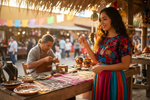
A World of Jewelry Traditions: Mexico, No. 3
29 min reading time
29 min reading time
Mexico's jewelry traditions span thousands of years, blending the artistry of ancient Mesoamerican civilizations with Indigenous craftsmanship, Spanish colonial influences, and contemporary design. From the sacred jade and gold of the Maya and Mixtec to the world-famous silver of Taxco, Oaxaca's delicate filigree, Chiapas amber, and the symbolic beadwork of the Wixárika people, each region reflects its own history, materials, and cultural identity. Rather than one unified style, Mexico offers a remarkable collection of living jewelry traditions that continue to evolve while preserving centuries of artistic knowledge.
How Ancient Civilizations, Regional Materials, and Master Artisans Created One of the World's Most Distinctive Jewelry Legacies
20 min reading time
Mexico's jewelry traditions span thousands of years, blending Mesoamerican artistry, Indigenous craftsmanship, Spanish colonial influences, and contemporary design.
Mexico's jewelry traditions span thousands of years, blending the artistry of ancient Mesoamerican civilizations with Indigenous craftsmanship, Spanish colonial influences, and contemporary design. From the sacred jade and gold of the Maya and Mixtec to the world-famous silver of Taxco, Oaxaca's delicate filigree, Chiapas amber, and the symbolic beadwork of the Wixárika people, each region reflects its own history, materials, and cultural identity. Rather than one unified style, Mexico offers a remarkable collection of living jewelry traditions that continue to evolve while preserving centuries of artistic knowledge.
Mexico's jewelry traditions reach across thousands of years and countless communities. The Olmec, Maya, Mixtec, Zapotec, Mexica, and other Mesoamerican civilizations transformed jade, turquoise, shell, obsidian, gold, silver, coral, and feathers into objects of beauty, ceremony, protection, and power, long before contact with the European explorers.
Jewelry was rarely decorative alone, it was a means of communicating; greenstones were associated with life, water, fertility, and renewal, turquoise communicated prestige and sacred significance, shells connected inland communities to distant coasts, while gold evoked the brilliance and energy of the sun.

After the Spanish arrived in the 16th century, European metalworking, filigree, and religious imagery added a layer to an already sophisticated artistic world. Indigenous artisans did not simply abandon their traditions; they adapted new techniques and materials, creating regional forms that blended Indigenous knowledge with Spanish, Moorish, colonial, and later modernist influences.
The result is that there is not one homogenous Mexican jewelry style. Instead they've gifted us with an extraordinary collection of living traditions. From the sculptural silver of Taxco and delicate filigree of Oaxaca to Chiapas amber, Maya-inspired stone carving, and the symbolic beadwork of Wixárika artists, Mexico's jewelry continues to express cultural memory, community identity, and artistic innovation.
Silver, gold, jade and other greenstones, turquoise, amber, obsidian, shell, coral, brass, copper, glass beads
Silversmithing, repoussé, chasing, filigree, lost-wax casting, stone carving, beadwork, stamping
Olmec, Maya, Mixtec, Zapotec, Mexica, Wixárika, Spanish Colonial, Moorish, modernist
Pre-Hispanic Mexico, Taxco and Guerrero, Oaxaca and the Isthmus of Tehuantepec, Chiapas, the Maya world and Yucatán, Wixárika communities of western Mexico
Jewelry that preserves cultural identity while continually absorbing new materials, techniques, and ideas

Mexico's jewelry traditions reveal very different stories: from Taxco's sculptural silver to Oaxacan filigree, Chiapas amber, and Wixárika beadwork.
While every artisan and community has its own distinctive style, these characteristics provide a helpful starting point for recognizing Mexico's remarkable regional jewelry traditions.
Jade and other greenstones, turquoise, gold, shell, obsidian, coral. Stone carving, lost-wax casting, hammering, inlay, mosaic work. Serpents, birds, jaguars, maize, water, deities — expressing cosmology, status, and spiritual power.
Sterling silver, turquoise, amethyst, onyx, obsidian, enamel. Sculptural silversmithing, repoussé, chasing, articulated construction. Pre-Hispanic forms, animals, architectural curves inspired by Mexico's archaeological heritage.
Gold, silver, brass, copper, gilded metals, coins. Fine hand-formed filigree. Flowers, birds, spirals, coins — metalwork integrated with ceremonial dress and regional identity.
Amber, silver, gold-toned metals. Cutting and polishing amber, sometimes combined with filigree. Leaves, flowers, insects, organic silhouettes — luminous resin connecting craftsmanship with the natural world.
Jadeite and other greenstones, shell, obsidian, gold, silver. Lapidary carving and inlay; later gold and silver filigree. Maize, serpents, jaguars, glyphs — expressing ancestry and the sacred.
Glass seed beads, thread, shells, metal findings. Intricate threaded beadwork and bead-mosaic construction. Deer, peyote, maize, eagles, serpents — saturated color preserving sacred stories and cultural memory.
The Remarkable Jewelry Traditions of Ancient Mexico
Mexico's jewelry story did not begin with silver mining or colonial workshops. It began centuries earlier in the courts, temples, trade networks, and artisan communities of Mesoamerica.
Archaeological discoveries reveal ornaments made from materials obtained across enormous distances. Shells traveled from the Pacific and Caribbean coasts. Turquoise circulated through networks extending into northern Mexico and the American Southwest. Greenstones, including jadeite, were carved into beads, pendants, masks, ear ornaments, and ceremonial objects.
Among the Mixtec, goldsmiths became renowned for exceptionally detailed metalwork. They used techniques including lost-wax casting, hammering, joining, and false filigree to produce pendants, rings, bells, pectorals, and ornaments filled with religious and political meaning.
The treasure discovered in Tomb 7 at Monte Albán includes an extraordinary collection of Mixtec ornaments made from gold, silver, turquoise, obsidian, greenstone, shell, and other materials. The collection provides an important record of the region's artistic and ceremonial traditions.
The Mexica also valued jade, turquoise, shell, gold, feathers, and obsidian. These materials communicated rank and spiritual authority, but they also represented the geography of an interconnected world. A single ornament could embody the labor of miners, traders, lapidaries, goldsmiths, featherworkers, and political leaders.
Ancient Mexico reminds us that the value of a material is not just its rarity, but by the beliefs and relationships a culture places within it.

The Reinvention of Mexican Silver

High in the mountains of Guerrero, Taxco is recognized throughout the world for silver. Its identity developed through several distinct chapters: pre-Hispanic metalworking, colonial mining, and a twentieth-century design revival that transformed the city into an international center of modern jewelry.
Silver mining expanded under Spanish rule, but the jewelry most closely associated with Taxco today took shape much later. During the 1920s and 1930s, American architect and designer William Spratling established a workshop that brought local silversmiths together with artists, designers, and craftspeople.
Spratling drew heavily from Mexican archaeology, architecture, nature, and folk art. More importantly, his workshop helped train and support artisans who would establish influential studios of their own. Designers including Antonio Pineda, Héctor Aguilar, Margot van Voorhies Carr, Los Castillo, and others developed distinct artistic voices, helping Taxco silver gain international recognition.
Taxco jewelry can be bold and sculptural or delicate and intricately worked. Some pieces feature hammered surfaces, repoussé decoration, chasing, oxidized recesses, or articulated construction. Others combine silver with turquoise, amethyst, onyx, enamel, obsidian, or pre-Hispanic-inspired imagery.
Taxco reminds us that a tradition can be deeply rooted in history while still becoming a laboratory for new design.
Filigree, Ceremony, and Cultural Identity
Oaxaca is one of Mexico's most culturally diverse states, home to numerous Indigenous communities and artistic traditions. Its jewelry reflects this diversity rather than conforming to a single regional style.
Gold and silver filigree are among Oaxaca's most recognizable traditions. In filigree, metal is drawn into extremely fine wires, then twisted, curled, shaped, and soldered into openwork patterns. The resulting jewelry may appear as light as lace, despite the technical precision required to make it.
The technique arrived through Spanish and broader Mediterranean metalworking traditions, which themselves carried Moorish influences. In Oaxaca, artisans transformed it into something distinctly regional, incorporating local forms, ceremonial uses, and personal innovations.


Contemporary Oaxacan master artisans continue to create filigree completely by hand, forming spirals and other decorative elements from fine silver wire before assembling them into earrings, pendants, chains, rings, and necklaces.
Filigree is especially important in the Valles Centrales and the Isthmus of Tehuantepec. Isthmus jewelry is closely associated with the elaborate dress of Zapotec women, particularly for weddings, festivals, religious celebrations, and the region's velas.
Large earrings, chains, necklaces, crosses, coins, and floral ornaments become part of a complete visual language that includes embroidered huipiles, skirts, flowers, and carefully styled hair.
The gold appearance traditionally favored in the Isthmus does not necessarily mean every contemporary piece is solid gold. Artisans may work in silver, brass, copper, or gilded metals, reflecting both changing material costs and the continued cultural importance of a warm golden palette.
Oaxaca reminds us that jewelry does not exist in isolation. It becomes part of a larger language of clothing, celebration, family, and place.
Amber, Ancient Forests, and Living Craft


In Chiapas, jewelry begins with a material created millions of years before the first artisan touched it.
Amber is fossilized tree resin, and deposits found in Chiapas are known for colors ranging from pale yellow and honey gold to cognac, reddish brown, and occasionally greenish or unusually clear tones. Natural inclusions may preserve tiny fragments of ancient plant or insect life, making each piece a small record of a vanished ecosystem.
Amber has been used in Mesoamerica since pre-Hispanic times. It traveled through trade networks and was valued for adornment, ritual, and protective associations. Today, it remains closely identified with communities around Simojovel and with jewelry workshops and markets in San Cristóbal de las Casas.
Artists cut, shape, sand, and polish the material to reveal its translucence and inner character. Some designs allow the amber to remain organic and irregular, while others shape it into polished beads, cabochons, flowers, animals, pendants, or contemporary geometric forms.
Amber is frequently combined with silver filigree. Chiapas is one of several Mexican regions with a continuing filigree tradition, creating a natural marriage of luminous resin and fine metalwork. Cultural training programs in Mexico recognize distinct filigree traditions in Oaxaca, Chiapas, Guerrero, and Yucatán.
Chiapas reminds us that some materials carry the story of the earth that created them and the story of the artisan who reveals their beauty.
Greenstone, Shell, and the Language of the Sacred
Across the ancient Maya world, jewelry communicated rank, identity, spiritual power, and relationships with gods and ancestors.
Jadeite and similar greenstones were highly valued as their color evoked water, maize, vegetation, breath, and life itself. Maya artisans transformed them into beads, ear flares, pendants, plaques, masks, and funerary ornaments.
It is important to distinguish cultural tradition from geological origin. Much of the jadeite used by ancient Maya artists came from deposits in what is present-day Guatemala, and not the Yucatán Peninsula itself.
Shell was also important. Conch, oyster, and other marine materials were carved into beads, pendants, ear ornaments, and inlays. Obsidian introduced a dramatic contrast: black, reflective, sharp, and closely associated with ritual and exchange.
In colonial and modern Yucatán, filigree became another important tradition. Artists in Mérida and surrounding areas developed delicate earrings, rosaries, necklaces, crosses, and ceremonial pieces from fine gold or silver wire.
The region therefore carries both an ancient lapidary inheritance and a later metalworking tradition shaped by cultural exchange.
Contemporary jewelry inspired by Maya imagery often incorporates glyph-like forms, maize, serpents, birds, masks, and calendrical symbols. Some of these designs should be approached with consideration as there is a meaningful distinction between respectful work created by artists connected to the culture, and mass-produced objects that use sacred imagery without context.
The Maya world reminds us that jewelry can carry ideas about life, ancestry, nature, and the cosmos across generations.


Among the Wixárika people of western Mexico, known to many outsiders as the Huichol, art is inseparable from spirituality, community, and cultural memory. Wixárika is the preferred singular term; Wixaritari refers to the people collectively.
Contemporary Wixárika beadwork is immediately recognizable for its saturated color and intricate patterning. Artists create necklaces, bracelets, earrings, rings, ceremonial objects, and sculptural works using small glass beads known in Mexico as chaquira.
The beads are a relatively recent addition compared with the traditions they express. Before glass beads became widely available, artists worked with seeds, shells, bone, clay, and other natural materials. Wixárika artists incorporated the newer material into an existing symbolic world rather than replacing it.
Common imagery includes deer, maize, peyote, serpents, eagles, scorpions, flowers, water, fire, and the sun. These are not merely decorative motifs. Many relate to sacred narratives, pilgrimage, agriculture, protection, transformation, and relationships between people and the natural world.
Some beadwork is threaded to create flexible jewelry. In other works, beads are carefully applied to surfaces to create dense mosaics. The placement of thousands of tiny elements requires patience, precision, and a sophisticated understanding of color and pattern.
Women artists play a particularly important role in preserving and evolving Wixárika textile and bead-jewelry traditions. Research published by INAH describes bead jewelry as one of the forms through which Wixárika women represent symbols and figures drawn from their worldview and sacred narratives.
Wixárika jewelry reminds us that pattern can serve as memory, symbolism, and cultural continuity — not simply decoration.
Northern Mexico does not have one unified jewelry identity. Its enormous geography includes mining communities, ranching cultures, urban design centers, border regions, and the homelands of Indigenous peoples including the Rarámuri, Comcaac, Yaqui, and Mayo.
Silver, copper, leather, shell, turquoise, and locally available natural materials appear in different forms throughout the region. Trade routes connected northern Mexico to the American Southwest long before the modern border existed.
Contemporary northern Mexican jewelry often reflects overlapping influences: Indigenous traditions, mining history, ranching culture, religious imagery, modern urban design, and exchange with the southwestern United States.
This complexity is precisely why northern Mexico should not be reduced to "Southwestern jewelry." Its traditions were shaped by the histories, materials, and meanings of these communities.
Northern Mexico reminds us that modern borders cannot fully contain the movement of materials, techniques, and cultural ideas.
Mexico's regional traditions differ greatly, but several recurring ideas bring them together.
Jewelry may communicate community, family, faith, status, celebration, or cultural belonging, often alongside textiles, hairstyles, and ceremonial clothing.
Amber connects jewelry to the ancient forests of Chiapas. Silver evokes Guerrero's mining history. Shell reflects coastal trade, while jade and turquoise reveal Mesoamerican networks.
Spanish filigree became Oaxacan and Yucatecan. Imported glass beads became part of a distinctly Wixárika artistic language. Modernist design reshaped Taxco without severing its connection to Mexico's past.
Many techniques survive through families, workshops, apprenticeships, and communities. The strike of a hammer or the selection of one bead among hundreds is learned through practice.
Mexican jewelry is not frozen in the past. Contemporary artists continue to innovate, combining inherited techniques with new forms, materials, and personal points of view.
Mexico's jewelry traditions reveal how culture survives by continuously evolving and adapting. Ancient materials take on contemporary forms. Imported techniques are incorporated. Symbols span generations, and the artists reinterpret them through their own experience and imagination.
At Sundara Joon, this is why we believe jewelry is more than an accessory. It is a connection to culture, to craftsmanship, and to the artisans whose work carries knowledge from one generation into the next.
Our hope is that this series encourages you to look beyond a piece's surface and consider the many hands, materials, places, and histories that brought it into being.
Because when we appreciate the craft, we also honor the culture that created it.
Mexico's jewelry heritage is inseparable from its archaeology, regional arts, and living artisan communities. These resources provide a starting point for further exploration. Mexico's museums are world class, and these will suck you in.

Discover how metalwork, pearls, lacquer, nature, and ideas of restraint and imperfection shaped a jewelry tradition in which the smallest details often carry the greatest meaning.


