A World of Jewelry Traditions: China, No. 10
28 min reading time
28 min reading time
When the Material Itself Carries Meaning
From Ancient Jade and Imperial Adornment to Silver Work and Living Traditions
Estimated reading time: 14–17 minutes

Some jewelry traditions begin with a technique. Others begin with a ceremony, a community, or a particular way of wearing an ornament.
In China, one of the most enduring stories begins with a material. For thousands of years, jade has occupied an extraordinary place in Chinese cultural life. It has been fashioned into ritual objects, personal ornaments, symbols of rank and works of art. Its appeal cannot be explained by rarity or beauty alone. Jade's toughness, subtle luster, tactile qualities and the patience required to work it have all contributed to the meanings people attached to it.
Yet China's jewelry history extends far beyond jade. Gold and silver became instruments of extraordinary artistic expression. Pearls, coral, turquoise and gemstones contributed to elaborate court adornment. In southwestern China, Miao silversmiths developed distinctive ceremonial jewelry traditions in which metalwork, dress, movement and community identity come together.
Given these different histories, a question emerges:
How does a material become more than the substance from which an object is made?
China offers a particularly compelling answer.
China's jewelry traditions developed across a vast geography and thousands of years of cultural change. They reflect the work of different communities, the patronage of courts, the movement of materials through trade, and generations of accumulated craftsmanship.
Nephrite, jadeite, gold, silver, pearls, coral, turquoise, enamel and gemstones
Jade pendants, hair ornaments, court necklaces, silver collars, ceremonial headdresses
Dragons, phoenixes, flowers, bats, butterflies, auspicious characters
Abrasive jade carving, polishing, filigree, repoussé, chasing, inlay and enameling
Ritual traditions, philosophical ideals, court culture, regional identities and exchange networks
Materials acquire meaning through the people, practices and institutions that value them

China's jewelry history does not divide neatly into provinces. Some traditions belong to cultures that existed long before modern boundaries. Others developed around imperial workshops or regional centers of craftsmanship. and still others remain living traditions within particular communities.
The map identifies important centers and cultural reference points, not exclusive territories.
Materials: Nephrite and other stones. Palette: Green, brown, dark tones. Motifs: Animal forms, curved shapes. Signature: Abrasive working. Character: Early ritual objects.
Materials: Nephrite. Palette: Cream, green, brown. Motifs: Discs, cong forms, abstract faces. Signature: Cutting, drilling, polishing. Character: Highly developed Neolithic jade traditions.
Materials: Jade, gold, silver, pearls. Palette: Gold, white, green, red. Motifs: Dragons, phoenixes, auspicious imagery. Signature: Carving, inlay, metalwork. Character: Ritual, status and court adornment.
Materials: Jade. Palette: White, green, varied natural tones. Motifs: Flowers, landscapes, animals. Signature: Fine carving and polishing. Character: Detailed lapidary craftsmanship.
Materials: Jade, precious metals, pearls, enamel. Palette: Gold and multicolor. Motifs: Imperial and auspicious imagery. Signature: Combined luxury techniques. Character: Elaborate court objects.
Materials: Silver and silver alloys. Palette: Silver, often paired with colorful textiles. Motifs: Birds, butterflies, flowers and locally specific imagery. Signature: Hammering, repoussé, engraving. Character: Ceremonial ensembles and community traditions.
Materials: Gold, silver, enamel, gemstones. Palette: Gold, blue, green, red. Motifs: Floral and auspicious patterns. Signature: Filigree, enamel, inlay. Character: Intricate decorative craftsmanship.
Materials: Jade, gold, silver, pearls, mixed materials. Palette: Traditional and contemporary palettes. Motifs: Heritage motifs and modern forms. Signature: Traditional and contemporary techniques. Character: Continuity and reinvention.
Materials: Gold, jade, pearls, gemstones. Palette: Gold, green, white, multicolor. Motifs: Auspicious motifs, wedding jewelry. Signature: Goldsmith, setting, modern manufacture. Character: Cantonese traditions and international exchange.
When examining Chinese jewelry, begin with the material, and keep going. Notice whether jade has been left relatively simple or carved into intricate forms. Look at the relationship between gold, pearls and colored stones in court ornaments. Examine the scale and movement of silver pieces worn together in ceremonial dress. Finally, ask whether the object was made for everyday wear, ritual use, court display or a particular community occasion.
The answers may reveal more than the material alone.
Jade and the Sacred

Long before the rise of China's imperial dynasties, communities were already shaping jade into objects of extraordinary precision.
Among the most recognizable are the circular bi disc and the cong, a tube-like form with a circular opening and squared exterior. Examples associated with the Liangzhu culture, which flourished in the Lower Yangtze region during the late Neolithic period, demonstrate sophisticated techniques of cutting, drilling, grinding and polishing.
These were not simply early versions of modern jewelry. Some were substantial ritual objects, too large or heavy to wear.
Their exact meanings remain subjects of scholarly interpretation. Archaeological contexts suggest relationships with ceremony, status and burial practices, but we should be cautious about assigning one universal symbolism to every form.
What is unmistakable is the investment of labor as jade is exceptionally tough. Shaping it required patience, specialized knowledge and abrasive materials capable of gradually wearing away the stone.
Even thousands of years ago, the value of jade was inseparable from the human effort required to transform it.
The history of Chinese jade therefore begins not with a fashionable color, but with the relationship between material, technical skill and cultural significance.
When a Stone Becomes an Ideal
Over time, jade acquired associations extending well beyond ritual practice.
In classical Chinese thought, its physical qualities were used to express human virtues. Its luster could suggest benevolence or refinement; its durability, integrity; its carefully worked surface, the cultivation of character.
Jade was not valuable simply because it was believed to represent virtue. It was already a material of established cultural importance, shaped by ritual, craftsmanship, exchange and social practices. Philosophical associations added further layers to an evolving tradition.
Jade ornaments also accompanied the body in different ways: as pendants, belt fittings, hair ornaments and other objects whose forms and functions changed across periods.
The enduring appeal of jade lies partly in this relationship between physical material and accumulated cultural interpretation.
For readers interested in the stone itself, including the distinction between nephrite and jadeite, Sundara Joon explores these qualities in Why Jade's Timeless Allure Endures.


Not all jade used in China came from the same source, and the geography of supply changed over time.
Early Neolithic communities drew upon different regional sources of nephrite. In later periods, nephrite from the Hotan region became particularly significant in long-distance exchange. Jadeite from Myanmar gained prominence much later, especially during the Qing period.
The distinction between where a stone originated and where it was transformed into an object of cultural importance is central to understanding China's jade traditions.

The English word jade refers to two different minerals: nephrite and jadeite.
Nephrite dominates the earliest documented Chinese jade traditions. Jadeite, particularly material from Myanmar, became especially important in later Chinese jewelry and collecting.
Both may be green, and both occur in other colors. Their compositions differ, as do parts of their historical use.
Understanding this distinction makes it easier to appreciate why the history of jade is not simply the history of one gemstone, but two.

Gold, Pearls and the Language of Rank

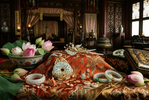
Jade may be China's most enduringly recognized material, but it was never the only one through which wealth, rank and beauty were expressed. Across different dynasties, court jewelry incorporated precious metals, pearls, gemstones and materials obtained through extensive exchange networks.
Gold could be worked into delicate filigree. Hair ornaments combined metals with colored stones and symbolic imagery. Pearls appeared in court adornment and ceremonial dress, with their significance depending on period, rank and cultural convention.
During the Qing dynasty, Manchu court traditions introduced particularly distinctive forms of dress and ornamentation. Certain pearls were associated with imperial privilege and the dynasty's northeastern ancestral connections.
The symbolism of court jewelry was not always obvious to an outside observer. A particular material, number of ornaments, motif or arrangement might communicate distinctions recognized within the court. Here, material meaning became closely connected to social institutions.
A pearl was not merely a pearl. Its origin, quality, placement and permitted use could matter.
For more about the natural material itself, see Sundara Joon's Luminous Pearls — The Queen of Gems.
The Carver's Art

A finished jade ornament can appear effortless, and yet that apparent simplicity can conceal an extraordinary amount of work. Jade is not shaped in the same way as a soft material cut quickly with an ordinary blade. Traditional methods relied on abrasion: progressively cutting, grinding, drilling, and polishing the stone.
The carver had to understand the material's structure, color variations, and potential flaws before deciding what form could emerge from it.
Suzhou and the broader Jiangnan region became associated with refined jade craftsmanship, while imperial workshops and other regional centers also contributed to the development of the art.
A skilled artisan might preserve an unusual natural feature, and rather than remove it, incorporate variations in color or translucency into the finished design.
The artistry lies not only in what was added, but also in what the maker chose to preserve in the stone.

The process reminds us that a material's cultural value and the maker's technical knowledge cannot be separated entirely.
Silver in Motion
If jade teaches us to look closely at a material's surface, Miao silver work in Guizhou invites us to consider jewelry in movement.
In many Miao communities, elaborate silver ornaments form part of ceremonial dress. Headdresses, collars, necklaces, pendants and other pieces may be worn together, creating ensembles of remarkable scale and visual impact. Some elements move or sound as the wearer walks or dances.
The effect is not simply decorative. Particular forms and combinations may carry associations with family, community identity, auspicious wishes, or important occasions.
No single universal Miao jewelry style exists as communities vary in their traditions, and their forms have changed over time.
Silver work also represents an accumulation of specialist skills: forging, hammering, engraving, soldering, and assembling components that must be both expressive and wearable.


The finished jewelry demonstrates how a material can participate in a much larger cultural expression involving clothing, ceremony, music, movement and collective memory.
It also challenges the assumption that China's jewelry heritage can be represented adequately by jade and imperial adornment alone.

Some materials transform light. Historical Chinese decorative arts included intricate metal filigree, colorful enamel and ornaments incorporating the iridescent blue-green feathers of kingfishers.
The feather technique commonly called dian cui was associated with elaborate ornamentation during the Ming and Qing periods, although feather decoration has a longer history.
Its vivid color came from the structure of the feathers and their interaction with light, rather than from an ordinary blue pigment.
Such objects demonstrate the remarkable inventiveness of artisans working across different materials.
They also invite questions about conservation and wildlife protection. Historical craftsmanship can be appreciated without suggesting that practices involving wild birds should be revived unchanged.


Along a tree-lined Shanghai street, older architectural styles and familiar storefronts share the view with modern skyscrapers rising in the background. The scene captures something distinctive about the city: continuity and transformation are not always separate chapters in its history. Often, they exist side by side.

During my visit to Shanghai, once I got over the awe of the scale of the city, I was struck by the city's different layers. Historic streets, modern commercial districts, and the architecture along the Bund offered contrasting views of a place shaped by centuries of change.
That experience provides an interesting way to think about China's jewelry traditions. A city can preserve elements of its past while continually reinventing itself, as Shanghai does with such verve. Jewelry traditions can do something similar. Materials such as jade, gold and pearls retain longstanding cultural associations, yet the ways they are designed, displayed, purchased and worn continue to evolve.
The connection is seeing these different expressions of the city alongside one another reminds us that cultural continuity does not require everything to remain unchanged.
Traditions endure partly because people continue to find new ways to engage with them.


My experience in Hong Kong offered a different perspective. I visited with my sister; it was her first trip abroad, and it was fascinating to also see it through her eyes. One of our memorable experiences was exploring a historic jade market, where we discovered that shopping could be as much, if not more, about the exchange between people as the objects themselves.
We learned firsthand the art of bargaining. It was an experience that required us to pay attention, engage with the vendors and participate in a way that was quite different from walking into a conventional retail store.
What stayed with me was not simply the prospect of negotiating a price, but the experience itself, the conversation, the interaction and the opportunity to appreciate a different marketplace culture.
That memory offers another way of thinking about jewelry traditions. Objects move from makers to merchants and ultimately to wearers, but the relationships surrounding those exchanges can also become part of their stories. Markets are places where many elements: craftsmanship, commerce, personal taste and cultural practices meet, and if my experience is any indication, neat it is not.
Hong Kong has its own distinctive history of jewelry commerce, jade trading and goldsmith, shaped by its Cantonese cultural heritage and global connections. My market visit was not necessarily an encounter with those particular jewelry traditions, but a reminder that the experience of acquiring an object can be meaningful in its own right.
Sometimes what we bring home is more than what we purchased. It is the memory of how we found it.
China, like the other countries we've explored has no one defining jewelry style. Neolithic jade objects, Qing court hair ornaments and Miao ceremonial silver work belong to different communities, periods and systems of meaning. The contemporary jewelry cultures of Shanghai and Hong Kong add further dimensions. What connects them is not a single appearance or technique.
It is the relationship between materials and the human knowledge that transforms them.
A stone becomes a ritual object through craftsmanship and ceremony.
A pearl becomes an indicator of courtly distinction through social convention.
Silver becomes part of community identity through generations of making, wearing and recognition.
In contemporary settings, inherited materials and motifs continue to find new expressions.
The material matters, but meaning is created through human relationships with that material.
The next time you encounter a piece of Chinese jewelry, begin with five questions:
These questions help us appreciate jewelry without reducing an entire culture to a handful of recognizable symbols.

In Thailand, we looked more closely at the maker.
In Morocco, at the wearer.
In Ghana, at the community that recognizes the significance of adornment.
China invites us to begin with the material. The deeper lesson is not that jade naturally represents virtue, or that silver communicates identity. Materials can accumulate meaning through generations of craftsmanship, belief, exchange and use. A stone is shaped by an artisan, but its significance is shaped by people. And those meanings may continue to evolve long after the original object was made.
China's jewelry traditions offer an important reminder: understanding a material can change the way we appreciate a piece of jewelry.
Jade provides a particularly compelling example. Its color, texture and natural variations influence what an artisan can create, but it is the maker's knowledge and judgment that transform those qualities into a finished design. Pearls offer a different expression of the same relationship. Their natural variations in shape, luster and color can become part of a design's character rather than imperfections to be concealed.
At Sundara Joon, this appreciation for materials is closely connected to the independent artisans whose work we feature. Whether working with jade, pearls, silver, brass or other materials, these designers make choices about form, balance, texture and the natural characteristics of each component. Those decisions help explain why two pieces made from similar materials can feel entirely different.
We also believe that jewelry's meaning does not end with the maker. A piece may be selected because of its craftsmanship, an unusual gemstone, a distinctive design or simply because it speaks to the person wearing it. Over time, it may acquire personal associations that its maker could never have anticipated.
The Chinese traditions explored here are distinct from the contemporary jewelry featured at Sundara Joon. Yet they encourage the same kind of curiosity: looking beyond the finished object to understand the material, the skill involved in shaping it and the meaning it may acquire through use.
The material gives the artisan possibilities. The artisan gives it form. The wearer gives it a place in their own story.
Every country adds another way of understanding the relationship between jewelry and culture.
Explore the growing collection in A World of Jewelry Traditions.
From the traditional earrings of Dubrovnik and the filigree of the Dalmatian coast to the regional identities of inland Croatia, our next journey explores how jewelry reflects the meeting of Mediterranean, Central European and Balkan traditions.


