
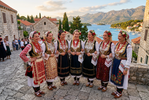
A World of Jewelry Traditions: Croatia, No. 11
27 min reading time
27 min reading time
Jewelry That Carries a Sense of Place
From the goldsmiths of Dubrovnik to the silver buttons of Šibenik and the embroidered traditions of Slavonia, Croatian jewelry tells stories of family, craftsmanship and belonging.

Dubrovnik’s Old Town and harbor. Photo: Spencer Davis on Unsplash
Jewelry often tells us something about the person wearing it. In Croatia, it can also tell us something about where that person comes from.
Along the Adriatic coast, delicate gold earrings, intricate silver buttons and coral necklaces reflect centuries of maritime exchange and local craftsmanship. As you progress inland, gold embroidery, coin ornaments and elaborate ceremonial dress reveal different traditions of celebration and family identity.
These traditions are far from uniform as evidenced by Croatia's islands, coastal towns and inland communities developing distinctive forms of adornment, influenced by geography, commerce, religion, local customs and changing economic circumstances.
Some jewelry became treasured family possessions, while other pieces formed part of traditional dress, marking occasions such as weddings and community celebrations, and still others have found new life in contemporary jewelry. What connects them is not a single technique or material, but something less tangible: the ability of jewelry to carry a sense of place across generations.

Croatia's jewelry traditions reflect its regional diversity, from Adriatic goldsmith and silver filigree to inland coin ornaments and ceremonial dress.
Croatia's geography helps explain the diversity of its adornment. The Adriatic connected coastal communities with Mediterranean trade networks, while inland regions maintained strong connections with Central and Southeastern Europe.
The following table offers a guide to recognizing some of these traditions. It is a starting point as jewelry forms and customs often crossed regional boundaries.
| Region | Materials | Palette | Motifs and forms | Signature technique | Distinctive character |
|---|---|---|---|---|---|
| Dubrovnik & Konavle | Gold, silver, coral, pearls | Warm gold, red, white | Verižice, fjočice, necklaces | Goldsmith, filigree | Family inheritance and ceremonial dress |
| Šibenik & Dalmatia | Silver, sometimes gold | Silver, gold | Spherical botun buttons | Filigree and decorative metalwork | Traditional dress transformed into modern jewelry |
| Pag | Gold, silver, textiles | Gold, white, silver | Ročini earrings, peružini necklaces | Jewelry-making and distinctive textile lacemaking | Jewelry integrated with elaborate regional costume |
| Kvarner & Adriatic islands | Gold, silver, coral | Gold, red, silver | Regional earrings, pendants, necklaces | Metalworking and maritime exchange | Island identities shaped by trade and local customs |
| Slavonia & inland Croatia | Coins, beads, metals, gold thread | Gold, red, white, multicolored | Coin necklaces, embroidered garments | Zlatovez, beadwork, ceremonial ornament | Celebration, family resources and community identity |
The Adriatic as a Place of Exchange
Croatia's coastline has long been a meeting place of peoples, goods and ideas.
Ancient Greek and Roman settlements, Byzantine connections, Venetian influence, the Republic of Ragusa and later political relationships with Central European powers all contributed to the region's material culture.
Jewelry moved through these networks alongside textiles, precious metals, coral and other valuable goods. Techniques traveled, but they did not necessarily remain unchanged.
A form encountered in one community could be adapted to suit another's clothing, tastes or social customs. Over time, these adaptations could become so closely associated with a particular place that they were recognized as local traditions.
This is an important distinction. A jewelry technique does not need to originate in a community to become part of that community's cultural identity.
Filigree provides an especially useful example. It appears across the Mediterranean and far beyond, yet the objects produced with it differ considerably in shape, function and meaning.
In Croatia, those differences are particularly visible when we move from Dubrovnik to Šibenik, Pag and the islands.
Jewelry Kept Close to the Family
Dubrovnik's history as a maritime trading center helped sustain a sophisticated tradition of goldsmiths. In the surrounding Konavle region, jewelry also became an important element of traditional clothing and family customs.
The region's earrings are among its most recognizable forms.
Traditional verižice earrings were not exclusively reserved for weddings or other major ceremonies.
Smaller versions could be worn by girls, while larger and more elaborate forms were associated with adulthood and marriage. This progression illustrates how jewelry could accompany a person through different stages of life.
The more elaborate fjočice, associated with ceremonial and wedding dress, demonstrate the refinement of regional goldsmith techniques.
Their importance was not solely decorative. Such jewelry could contribute to a family's valued possessions and be passed between generations.

Traditional Konavle earrings illustrate how goldsmith techniques, ceremonial dress and family customs became closely connected.
Another important form is the kolarin, a necklace associated with traditional dress in the Dubrovnik region.
Historical examples include combinations of gold elements, filigree and coral. A 19th-century example documented in the Dubrovnik Museums collection provides a tangible connection to this regional tradition.
Coral is particularly interesting in an Adriatic context. Its presence connects personal adornment with the sea, Mediterranean commerce and the circulation of valued materials.

But the meaning of a necklace cannot be understood through materials alone. Its significance also depended on who owned it, when it was worn, how it was acquired and whether it was inherited.
A necklace, while admired for its workmanship, or valued for its materials, was treasured because it belonged to a mother or grandmother.
These meanings could coexist.
The broader traditions of Konavle dress help explain why jewelry mattered.
Silk embroidery, carefully constructed garments and distinctive accessories created a complete ceremonial ensemble. Earrings and necklaces were part of that ensemble, not isolated decorations.
Looking at the jewelry alongside the clothing reveals how craftsmanship, family life and community expectations shaped the way people presented themselves.
When a Button Becomes a Symbol
Not every important jewelry tradition began as jewelry.
The Šibenik botun is an especially compelling example. Traditionally associated with men's ceremonial clothing, the botun is a decorative metal button, often made in silver with intricate filigree work.
Its rounded form and elaborate surface distinguish it from an ordinary functional fastener.
The button was part of a larger tradition of regional dress, where ornament could communicate local affiliation, social position and participation in important occasions.

The Šibenik botun evolved from an ornamental element of traditional men's clothing into a recognizable form in contemporary Croatian jewelry.
Today, the botun appears in earrings, pendants and other accessories. Its transformation is significant because it demonstrates how a traditional object can acquire new uses while retaining a recognizable connection to its origins.
A woman wearing botun-inspired earrings today may provide a contemporary expression of regional heritage. Preserving a tradition does not always mean preserving an object's original function. Sometimes continuity lies in the form, the technique, or the story that accompanies it.
Making Something Delicate from Metal
Filigree is one of the techniques that connects several Croatian jewelry traditions with a much wider world of metalworking.
At its simplest, filigree involves shaping fine metal wires into decorative patterns. The wires may be twisted, curled, arranged and soldered into an intricate structure.
The results can appear almost lace-like, despite being made from metal.
Although methods vary among workshops and traditions, the process generally involves several stages:
Drawing or selecting fine wires suitable for the design.
Twisting, curling, or bending the metal into decorative elements.
Positioning the elements within a framework or around other components.
Carefully soldering the wirework to create a stable piece.
Clean, refine, and polish the completed ornament.

Fine metal wires are shaped and joined to create the intricate patterns characteristic of filigree jewelry.
The technique requires precision and patience. Small differences in wire thickness, arrangement, and finishing can change the character of the completed piece.
We have already encountered filigree in our exploration of Sardinia, where it has a distinctive place in regional jewelry. Croatia offers another perspective.
The shared technique does not mean that Croatian and Sardinian jewelry have identical histories or meanings. Each tradition developed within its own cultural and economic circumstances.
Later in our journey, Colombia will offer another opportunity to examine filigree through the goldsmith traditions of Mompox. These comparisons invite a larger question:
When a technique travels between cultures, what remains recognizable, and what becomes distinctly local?
It is a question worth revisiting as our journey continues.
Jewelry as Part of a Complete Ensemble

Traditional women's dress from Pag brings together distinctive textiles, lacework, and jewelry in a recognizable regional ensemble.
The island of Pag is widely known for its distinctive lace tradition. Its traditional dress provides an opportunity to understand jewelry as part of a larger visual language.
The elaborate garments, headdresses, lacework, and ornaments worn on ceremonial occasions were designed to be seen together.
Traditional jewelry associated with Pag includes ročini earrings, recognizable for their dangling forms, and peružini necklaces, associated with decorative filigree beads.
These forms contributed to the appearance of traditional dress and helped distinguish the island's regional identity.
Pag's celebrated textile lace and the openwork patterns of metal filigree share an apparent visual delicacy.
But they are different crafts.
Textile lace is created through the manipulation of threads, while metal filigree relies on shaping and joining fine wires.
Their visual similarities do not establish that one developed from the other.
What is interesting is how both could contribute to an ensemble in which fine workmanship and intricate patterning were highly valued.
Elsewhere along Croatia's coast and islands, jewelry traditions developed through combinations of local craftsmanship, trade and changing fashions.
Coral, gold and silver appear in different regional forms, while earrings and necklaces could be closely associated with particular styles of dress.
It would be misleading, however, to describe all Adriatic island jewelry as one tradition.
The differences between communities are part of the story.
Where Clothing Is an Ornament
Travel inland from the Adriatic and the visual character of traditional adornment changes. In Slavonia and other inland regions, elaborate textiles, beads, coin ornaments and ceremonial clothing often played prominent roles.
Here, the relationship between jewelry and clothing becomes especially important.
Coin ornaments, including dukati necklaces, are among the recognizable features of Slavonian festive dress.
Such ornaments could express family resources and social standing, while also contributing to the appearance expected for important celebrations.
Yet an important distinction deserves attention: not every coin ornament was made from genuine gold currency.
Museum collections document examples made from less expensive materials, including gilded imitations.
This reminds us that the appearance of wealth and the monetary value of the materials were not necessarily the same.
Jewelry could communicate aspiration, tradition or ceremonial importance as well as actual economic resources.

Traditional Slavonian festive dress combines embroidered textiles and coin ornaments, reflecting craftsmanship, celebration, and family resources.
Slavonia is also associated with zlatovez, decorative embroidery using metallic threads.
The elaborate patterns of gold embroidery could be as visually important as the jewelry worn with a garment.
Floral motifs, carefully worked surfaces and the interplay of metallic threads with colored fabrics helped create a richly ornamented ensemble.
In this context, the boundary between jewelry and clothing becomes less useful.
Both contributed to the visual presentation of the wearer.
Traditional dress was often worn for particular occasions, including weddings, festivals and other community gatherings.
The meaning of an ornament depended partly on these settings.
A coin necklace or embroidered headdress might carry different associations depending on the community, period and circumstances in which it was worn.
Rather than treating every richly decorated garment as a display of extravagance, it is more useful to ask what the ensemble communicated within its own social setting.
Croatian Jewelry Today
Croatia's jewelry traditions are not confined to museum collections.
Contemporary goldsmiths and designers continue to work with regional forms, techniques and materials.
Some reproduce established designs closely, maintaining recognizable historical forms. Others reinterpret familiar elements in new proportions, materials or combinations.
The Šibenik botun is one example, and the traditional Konavle earrings provide another.
A design once associated with ceremonial clothing may become an accessory worn in everyday life.

Contemporary Croatian jewelry makers reinterpret traditional regional forms while maintaining connections to inherited craftsmanship.
There is a temptation to think of tradition as something that must remain unchanged, but traditions have always responded to changing circumstances. Materials become more or less available. Clothing styles evolve. Customers develop new preferences. Craftspeople experiment with techniques.
The important distinction is between preserving knowledge and requiring every object to remain identical. Contemporary artisans can contribute to cultural continuity precisely because they continue to create.
Their work demonstrates that regional heritage can remain relevant without being frozen in the past.
The jewelry of Dubrovnik, Šibenik, Pag and Slavonia does not share one defining appearance.
Gold earrings, silver buttons, coin necklaces and embroidered garments differ substantially in materials, techniques and uses.
Yet several connections emerge.
It was worn with particular clothing, for particular occasions, and within recognizable community traditions.
Techniques, forms, and valued objects could be passed between family members or learned within workshops.
Specific designs became associated with places, even when the underlying techniques were known elsewhere.
An ornament could communicate family wealth, ceremonial participation, personal memory or regional belonging—and its significance could change over time.
Perhaps most importantly, Croatian jewelry demonstrates that belonging is not necessarily tied to remaining in one place.
An inherited pair of earrings can travel far from its original community while continuing to remind its wearer of family and home.
The next time you encounter a piece of Croatian jewelry, consider these questions:
These questions encourage us to look beyond appearance and consider the relationships that give an object meaning.
Can a piece of jewelry belong to a place even after it has traveled far beyond it?
Croatia's traditions suggest that the answer may lie in memory, craftsmanship, and the connections people maintain with the places they call home.
As our journey through jewelry traditions continues, different countries invite us to notice different things.
In Thailand, we considered the relationship between makers, communities and the continuity of craft.
In Morocco, jewelry revealed connections between materials, adornment and cultural identity.
In Ghana, we explored how ornaments can express community, status and shared history.
In China, we examined how the material itself—particularly jade—can carry layers of cultural meaning.
Croatia adds another perspective: the relationship between jewelry and a sense of belonging.
These lenses are not exclusive to any one country. They simply give us different ways to ask questions about objects we might otherwise admire only for their beauty.
Together, they encourage us to see jewelry as part of a much larger human story.
Croatia's jewelry traditions become more meaningful when viewed alongside the clothing, customs and communities that shaped them. These institutions offer opportunities to explore those connections.
Explore Konavle's regional heritage through traditional dress, embroidery, jewelry and objects associated with everyday life and ceremonial customs.
Discover traditional clothing and ornaments from the Dubrovnik region, including collections that help place jewelry within local family and cultural traditions.
Explore Croatia's diverse regional costumes, crafts and cultural practices, offering a broader perspective on how coastal and inland traditions developed.
Learn about the distinct lacemaking traditions of Pag, Lepoglava and Hvar, and the continuing importance of these skills within Croatian cultural heritage.
Explore traditional dress, textiles and decorative arts that help explain the cultural setting in which regional jewelry was worn.
At Sundara Joon, we are drawn to jewelry that reflects the individuality of its maker and the traditions that inform the work.
Croatia's jewelry offers a reminder that the meaning of an object can extend far beyond its materials or design. A pair of earrings may evoke a family celebration. A silver ornament may preserve a recognizable regional form. A contemporary piece may reinterpret craftsmanship developed over generations.
These are the connections that make artisan jewelry compelling.
We believe that understanding where traditions come from helps us appreciate the creativity of the people who continue to work with them. And while jewelry can carry the identity of a particular place, it can also connect people who live far apart.
That balance, between rootedness and exchange, is part of what makes the world's jewelry traditions so fascinating.
From Croatia's Adriatic coast, our journey crosses the Atlantic to Colombia, where jewelry opens another window into the relationship between craftsmanship, culture and identity.
Colombia's extraordinary history of goldwork stretches back long before European arrival. Its ancient ornaments reveal sophisticated techniques and complex relationships between materials, belief and community. Today, traditions such as the delicate filigree of Mompox demonstrate how craftsmanship continues to evolve.
Croatia has shown us how jewelry can express a sense of belonging. Colombia invites us to explore another question:
How do objects carry cultural memory when the societies around them change?
As our journey continues, connections between seemingly distant places become clearer. The filigree of Croatia, Sardinia and Colombia offer examples of how a shared technique can develop distinctive meanings in different communities.
Next stop: Colombia, where ancient artistry and living traditions invite us to look at jewelry through another lens.


