
Valentine’s Day: A Story of Love, Symbolism, and the Meaning Behind Jewelry Gifts
23 min reading time
23 min reading time
From medieval valentines and sentimental lockets to modern artisan jewelry, discover how jewelry became a Valentine’s Day gift and how to choose a piece with personal meaning.
Valentine’s Day is associated with roses, chocolates, cards, and jewelry. Its history, however, is not a single straight line from an ancient festival to the modern celebration of romance.
The day took shape gradually through Roman customs, Christian feast days, medieval poetry, handwritten messages, and eventually the growth of commercial gift giving. Jewelry entered that story because it could do something a flower or card could not: remain with the recipient and gather meaning over time.

What makes jewelry meaningful emerges from the relationship, the form of the piece, the materials used, and the story the giver and wearer attach to it.
The origins of Valentine’s Day are uncertain. Several traditions contributed to the holiday we recognize today, but historians cannot point to one definitive beginning.
The Roman festival of Lupercalia associated with purification, fertility, health, and the coming of spring was held in mid-February. It is frequently described as the direct origin of Valentine’s Day, although the relationship is not so simple. The two observances shared a February date, but there is no clear evidence that the modern romantic holiday descended directly from Lupercalia.
It is more accurate to see Lupercalia as part of the seasonal and cultural background from which later February traditions emerged.
There was more than one early Christian martyr named Valentine, and the surviving historical record does not establish which, if any, inspired the later celebration of lovers.
Stories about a priest who secretly married couples in defiance of Emperor Claudius II are part of later legend. They give the holiday a compelling theme of devotion and quiet resistance, but they should not be presented as verified biography.
The feast day of Saint Valentine became fixed on February 14. Its connection with romantic love developed much later.
The clearest shift toward romance occurred in medieval Europe. Geoffrey Chaucer’s fourteenth-century poem Parliament of Fowls linked Saint Valentine’s Day with birds choosing their mates. Other writers continued the association, helping February 14 become a day for courtship and affectionate messages.
By 1477, Margery Brews addressed her fiancé, John Paston III, as her “right well-beloved Valentine” in the oldest surviving Valentine’s Day letter written in English.

Paris, France
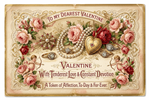
Handwritten valentines appeared by the sixteenth century. Printed cards became increasingly available in the eighteenth and nineteenth centuries, turning a literary and personal tradition into a widely recognized occasion for exchanging tokens of affection.

Jewelry did not begin as a Valentine’s Day product, as it already served as a language of affection, promise, remembrance, identity, protection, and status long before modern Valentine’s marketing emerged.
Rings could mark a vow or pledge. Lockets held portraits, inscriptions, or locks of hair. Engraved pieces carried messages known only to the giver and wearer. In Britain, posy rings bearing short expressions of love or friendship became established tokens by the Elizabethan period. Their inscriptions were often hidden inside the band, making the sentiment intimate rather than public.
During the 18th and 19th centuries, sentimental jewelry became especially elaborate. Lover’s-eye miniatures, hair jewelry, heart-shaped lockets, floral motifs, and gemstone acrostics allowed people to communicate affection, memory, and devotion through objects.

Explore the Silver Gemstone Heart Earrings →
As Valentine’s Day became increasingly commercial in the nineteenth and twentieth centuries, jewelry fit naturally into the celebration. It was already associated with courtship and remembrance, and it offered permanence in contrast with more temporary gifts.
That history explains jewelry’s appeal, but it does not mean every piece must follow a prescribed romantic code. The most meaningful gifts are usually the ones that respond to the individual rather than to a formula.
Valentine’s Day now extends well beyond traditional romantic couples. People use it to recognize:
This broader view does not weaken the holiday. It returns the focus to its most enduring idea: intentionally acknowledging someone who matters.

Explore the Amethyst Cuff →
A gift for a partner may express commitment. A gift for a close friend may mark years of companionship. A self-gift may celebrate growth, recovery, independence, or a new chapter. The occasion is shared, but the meaning is personal.
Red, pink, white, and gold dominate contemporary Valentine’s imagery, but their meanings are not universal or unchanging. Color symbolism depends on culture, religion, historical period, and personal experience.
Within modern Western Valentine’s traditions, these colors often suggest:
| Color | Common contemporary association | A more personal way to use it |
|---|---|---|
| Red | Passion, desire, vitality, courage | Choose it for someone drawn to bold color or expressive design |
| Pink | Tenderness, affection, warmth | Use soft or saturated pink according to the wearer’s style |
| White | Honesty, simplicity, purity, new beginnings | Let luminous materials such as pearls add quiet presence |
| Gold | Endurance, value, warmth, celebration | Choose it for its glow, longevity, or connection to jewelry the recipient already wears |
These are useful associations, but they are not fast rules. A blue gemstone, green jade piece, or silver sculptural earring can carry far more meaning than a conventional red heart when it reflects the person receiving it.
Jewelry forms do not possess fixed meanings on their own. Take a ring, which may signal commitment in one relationship and personal achievement in another. Earrings may be playful, ceremonial, or quietly familiar depending on the wearer.
Still, the way a piece is worn can create useful associations:
| Jewelry form | Associations it may suggest | What makes the choice personal |
|---|---|---|
| Ring | Continuity, intention, commitment, remembrance | The occasion, inscription, stone, or reason it was chosen |
| Necklace | Closeness, presence, protection, visibility | How it rests near the heart or frames a familiar style |
| Earrings | Individuality, confidence, movement, expression | The recipient’s face, hairstyle, comfort, and design personality |
| Bracelet or cuff | Connection, companionship, continuity | The way it moves with the wearer and becomes part of daily life |
| Pendant or charm | Memory, identity, aspiration, private meaning | A motif, material, place, or shared story understood by the recipient |

Explore the Delicate Silver Heart Earrings →
Rather than asking, “What does a bracelet always mean?” ask, “Why does this bracelet make sense for this person?” That small change turns symbolism from a marketing claim into genuine attention.

Gemstones add color, material history, and cultural associations. Those associations can enrich a gift, but no gemstone has one timeless or universal meaning.
| Gemstone or material | Selected associations | A thoughtful gifting approach |
|---|---|---|
| Pearl | Purity, status, wisdom, good fortune, adversity, and continuity in different traditions | Choose pearls for their luminosity, family associations, or modern elegance |
| Garnet | Protection, vitality, friendship, loyalty, and passion across different periods | Let its deep color or historical associations support the story of the gift |
| Amethyst | Sobriety and clear thinking in Greco-Roman tradition; later spiritual and royal associations | Choose it for someone who loves purple or connects with ideas of reflection and composure |
| Rose quartz | Widely associated today with affection, compassion, and emotional care | Present these as contemporary associations rather than universal ancient beliefs |
| Citrine | Modern associations with warmth, joy, optimism, and abundance | Choose it for its golden color and the feeling it evokes for the wearer |

Explore the Lily Pad Pearl Earrings →
A gemstone can honor a birth month, recall a place, echo a favorite color, or represent a private hope. The strongest meaning may have little to do with a popular gemstone guide and everything to do with the recipient.
A meaningful gift never needs to be extravagant. It needs to show that the giver has paid attention. Before choosing, consider five questions:

Explore the Floral Tendril Earrings →
The gift should communicate: I noticed what moves you. I chose this with you in mind.
At Sundara Joon, jewelry is more than adornment. It is a meeting point between the artist’s imagination, the knowledge held in their hands, and the life of the person who eventually wears the piece.
Many Sundara Joon designs are one of a kind or produced in micro-lots. They may feature traditional materials in unexpected forms, combine cultural influences through an artisan’s individual perspective, or simply offer a design that feels unlike anything mass-produced.
That makes them especially suited to Valentine’s gifting. The piece does not need to rely on a heart motif or a predetermined gemstone meaning. Its value can come from being carefully made, thoughtfully chosen, and unmistakably right for one person.
Some people love the directness of a heart, flower, or romantic color. Sundara Joon offers heart earrings, floral designs, pearls, garnets, and expressive gemstone pieces that speak easily to affection and connection.

Explore the Flaming Hearts Garnet Necklace →
Other recipients would rather receive something sculptural, kinetic, asymmetrical, or unexpected. Choosing a piece that reflects their individuality may be more romantic than choosing a conventional symbol of romance.
Unlike mass-produced jewelry, artisan-created work carries evidence of human decisions. The form, surface, color, and material combinations reflect someone’s creative point of view.
Not every artisan wishes to be publicly identified, and not every detail of a piece’s history is available. We share what is known while respecting those boundaries. What remains consistent is our belief in relationships, creative work at a human scale, and jewelry selected with care.
A Meaning That Lasts Beyond February 14
At its best, Valentine’s Day is an invitation to pay attention.
Jewelry became an enduring gift because it remains present long after the flowers fade and the card is stored away. Yet permanence alone does not make a piece meaningful. Meaning comes from the act of choosing well and from the memories the wearer adds afterward.
Whether the recipient is a partner, friend, family member, or oneself, the most resonant message is simple:
You are seen. You are valued. You matter.
Explore Sundara Joon’s latest artisan jewelry and find a piece chosen for its story.


