
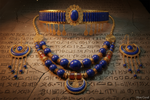
Rich Blue Lapis Lazuli
32 min reading time
32 min reading time
Lapis lazuli is a deep-blue metamorphic rock composed primarily of lazurite, calcite, and pyrite. Explore its ancient origins in Afghanistan, remarkable journey through Mesopotamia and Egypt, transformation into ultramarine pigment, cultural symbolism, natural variations, jewelry uses, identification, and proper care.

Few stones carry human history quite as visibly as lapis lazuli.
Its intense blue traveled extraordinary distances thousands of years before modern transportation, appearing in the jewelry and ceremonial objects of civilizations far from the mountains where it was mined. It adorned ancient Mesopotamian elites, entered Egyptian jewelry and amulets, and centuries later was transformed into ultramarine—one of the most prized blue pigments in the history of art.
Look closely at a piece of lapis and part of its appeal becomes obvious. Deep blue may be interrupted by cloudy white calcite or tiny flashes of metallic pyrite. The effect can resemble a night sky scattered with stars.
Yet lapis is unusual among familiar gemstones for another reason: it is not actually a single mineral.
Its beauty comes from several minerals existing together.
That combination of geology, ancient trade, art, symbolism, and extraordinary color has made lapis lazuli one of the most enduring materials in the history of adornment.
Lapis lazuli is a metamorphic rock rather than a single mineral.
Its characteristic appearance generally comes from a combination of:
Other minerals can also occur in lapis.
This mixed composition explains why two pieces can look remarkably different. One may be an almost uninterrupted ultramarine blue; another may contain clouds of white calcite; another may appear scattered with tiny pyrite stars.
Those variations are not necessarily flaws. They are part of the geological identity of the stone.

Why does it matter that lapis is a rock rather than a mineral?
Because it helps explain nearly everything we see when we look at it.
Unlike a gemstone defined by one mineral composition, lapis is the result of several minerals coming together. Its blue, white patterning, golden flecks, and variations from stone to stone are part of that natural combination.
Understanding that makes it easier to appreciate lapis not for perfect uniformity, but for character.
The most historically important source is the Badakhshan region of Afghanistan, where lapis has been mined for thousands of years.
The remote location makes what happened next particularly remarkable.
Long before airplanes, railroads, or modern roads, lapis from this mountainous region traveled enormous distances through ancient trade networks. It reached Mesopotamia, Egypt, and other centers of the ancient world, becoming evidence not only of a prized material but of surprisingly sophisticated connections among early civilizations.
Important lapis deposits are also associated with Chile, Russia, Pakistan, Myanmar, and other smaller sources.
Afghan lapis remains particularly celebrated for its intense blue color and extraordinary history.

The journey itself is part of the story. When lapis appears in an ancient object thousands of miles from Afghanistan, we are seeing more than a beautiful stone. We are seeing evidence of trade, movement, relationships, and the value people placed on beauty thousands of years ago.
“Lapis blue” sounds simple.
It isn’t.
Lapis can range from intensely saturated ultramarine to violet-blue and lighter denim-like shades. Some stones contain almost no visible white; others display dramatic calcite clouds. Some are scattered with tiny points of pyrite, while others contain bold metallic areas.
These differences affect conventional gem value—but they also affect artistic possibilities.
The color most strongly associated with fine lapis: rich, saturated, and visually intense.
Some stones have a subtle violet cast that can make the blue appear especially deep.
Tiny metallic inclusions create the familiar gold-speckled appearance. Fine, attractively distributed pyrite can add considerable visual character.
White or pale calcite creates streaks, clouds, and irregular patterns. Heavy calcite generally reduces the traditional commercial value of lapis, although an individual stone can still be visually striking.
A commercial term generally used for paler blue material with substantial white calcite, giving it an appearance reminiscent of faded denim.

Traditionally, highly valued lapis displays a strong, even blue with little visible calcite.
Small, well-distributed pyrite flecks can be attractive and do not automatically make a stone lower quality. Heavy white calcite generally has a greater negative effect on conventional grading.
But jewelry introduces another consideration: design.
A dramatically patterned piece of lapis may be less conventionally valuable than a uniform ultramarine specimen yet far more interesting in a one-of-a-kind piece of artisan jewelry.
That distinction matters at Sundara Joon.
Gemological uniformity and artistic beauty are not always the same thing. Sometimes the unusual streak, unexpected inclusion, or dramatic variation is exactly what gives an artisan something interesting to work with.
Learning about gemstones should help us look more closely—not tell us that there is only one way for a natural stone to be beautiful.
Few gemstones provide a clearer window into ancient trade, wealth, art, and cultural exchange.
By the third millennium BCE, lapis was appearing prominently in Mesopotamian jewelry and ceremonial objects.
The extraordinary finds from the Royal Cemetery at Ur included gold, carnelian, and lapis lazuli. Because the lapis had traveled from the region of modern Afghanistan, these objects also reveal the remarkable reach of ancient trade networks.
Lapis appears repeatedly in ancient Mesopotamian literature as well, including the Epic of Gilgamesh.
Lapis was used in Egyptian beads, amulets, scarabs, inlays, and jewelry.
Its extraordinary blue made it particularly suited to a culture in which color itself carried meaning. Imported lapis became part of combinations of brilliant materials—including gold, turquoise, and carnelian—that remain immediately recognizable in ancient Egyptian jewelry.
Lapis eventually acquired an entirely different life. Ground and carefully processed, it became natural ultramarine, one of history’s most prized blue pigments.
Its rarity and the difficulty of producing the pigment made ultramarine exceptionally costly. In medieval and Renaissance European art, it became associated with prestigious commissions and important sacred subjects, famously including the robes of the Virgin Mary.
A material that had traveled ancient trade routes as stone and jewelry was now traveling through history as color.
Lapis never disappeared. Contemporary designers continue to use it in beads, cabochons, sculptural forms, inlay, minimalist settings, and bold statement jewelry.
While its role has changed, its appeal has not.

The timeline reveals something unusual about lapis: it has not simply remained in use for thousands of years. Human beings have repeatedly found new ways to value it.
Stone became adornment. Adornment became symbol. Stone became pigment. And an ancient material continues to become contemporary jewelry.
Lapis has an unusual ability to feel ancient and modern at the same time.
In early jewelry, its intense blue provided extraordinary contrast with gold. It was shaped into beads, amulets, seals, inlays, and ceremonial ornaments. Later designers repeatedly returned to lapis when archaeological, historical, and global influences entered fashion.
Its saturated blue also works beautifully with the strong contrasts and geometry of modern design. Today, designers can take the stone in very different directions:
That adaptability helps explain why a stone worn thousands of years ago does not feel trapped in the past.
Over thousands of years, lapis has been associated with ideas including royalty, status, protection, wisdom, spirituality, beauty, and truth. But those meanings did not arise from one universal belief system.
Different societies encountered lapis at different times and gave the stone meaning within their own cultural worlds. Some associations are documented through objects, texts, religious traditions, and art. Others developed much later through modern spiritual and metaphysical practices.
Rather than assuming that lapis has always “meant” one thing, its history gives us something more interesting to explore: why people in different places have attached meaning to particular stones at all.
This is a subject we will explore more deeply in future Sundara Joon articles: the stones cultures have associated with luck, protection, love, status, spirituality, and other aspects of human life—and what those traditions tell us about the people who wore them.
Lapis is not one of the principal gemstones on today’s standard modern birthstone list.
Modern December birthstones are generally turquoise, tanzanite, and zircon. Lapis does appear in some older and alternative birthstone traditions, including associations with December and, in some systems, September.
That makes it an appealing alternative for someone who wants a birthstone connection without choosing one of the conventional modern stones.
Lapis generally measures approximately 5 to 6 on the Mohs hardness scale, although its mixed mineral composition means hardness can vary within the material. It is therefore softer than quartz, garnet, sapphire, or diamond. Lapis works particularly well for:
Rings and bracelets can certainly feature lapis, but they deserve more thoughtful wear because they are more likely to encounter hard surfaces.
Lapis deserves gentle care. Its mixed mineral composition means that, if some material has been treated, aggressive cleaning is unnecessary and potentially damaging.
Use a soft cloth and lukewarm water when needed. Mild soap can be used cautiously.
Avoid ultrasonic and steam cleaners, harsh household chemicals, acids, abrasive cleaners, and unnecessary contact with perfume, lotions, hairspray, or other beauty products.
Store lapis separately from harder gemstones that could scratch its surface.

The easiest rule is simple: put lapis jewelry on after beauty products, take it off before swimming, showering, cleaning, or strenuous activity, and store it thoughtfully when you are finished wearing it.
No. Lapis lazuli is a rock composed of several minerals, principally lazurite, calcite, and pyrite.
Not necessarily. Fine pyrite flecks can be attractive and are characteristic of many pieces of natural lapis. Heavy calcite generally has a greater negative effect on conventional quality grading than small, well-distributed pyrite.
No. Pyrite is common, but genuine lapis does not have to contain visible gold-colored flecks. A beautiful deep-blue specimen with little visible pyrite can be completely natural.
No. The two can look remarkably similar, particularly when both display blue and white patterning, but they are different gem materials.
Lapis lazuli is a rock composed of several minerals, while sodalite is a mineral. Pyrite is commonly associated with lapis but is typically absent from sodalite.

Looking at them side by side is often the easiest way to understand the difference. The comparison also illustrates why color alone is rarely enough to identify a gemstone.
Not automatically. Color is extremely important, but uniformity, calcite content, treatments, workmanship, and overall appearance also matter. Some artists may select a stone precisely because of an unusually patterned stone and not because of the blue
Yes. Lower-quality material can be dyed to intensify its blue color. Lapis may also receive wax or other treatments to improve its appearance. Reputable sources provide disclosures that identify what, if any, treatment took place.
The Badakhshan deposits have supplied exceptional lapis for thousands of years and were connected to some of the ancient world’s earliest long-distance luxury trade.
Natural ultramarine required high-quality lapis lazuli and a labor-intensive process to separate the desirable blue pigment from the other minerals in the rock. Before synthetic ultramarine became available in the 19th century, the natural pigment could be extraordinarily expensive.
Absolutely. Its history predates today’s gendered jewelry categories, and its strong blue works particularly well in both minimalist and statement designs.
Yes, depending on the jewelry.
Earrings and necklaces are particularly suitable for regular wear. Rings and bracelets need more care because lapis is relatively soft and can scratch or chip.
After thousands of years of history, the essentials are surprisingly simple.
Lapis lazuli is a metamorphic rock celebrated for its extraordinary blue, natural variation, and remarkable cultural history. It is softer than many familiar gemstones but very wearable when treated thoughtfully.
And perhaps most importantly, no two pieces are quite alike.
Lapis lazuli has never been merely blue. Thousands of years ago, someone extracted this extraordinary material from remote mountains, and another person carried it across landscapes most of us would struggle to cross today. Artisans shaped it into beads, seals, amulets, and objects of status and belief. Later, other hands ground the same blue stone into pigment and placed that color onto some of the world’s most treasured works of art. And we still wear it.
Perhaps that is what makes lapis so compelling. Its beauty is immediate, but its story is immense. Look closely at a piece, and you may see uninterrupted blue, a streak of white calcite, or tiny sparks of pyrite. What you see is geology at work. But you are also looking at a material that has moved through trade, art, faith, fashion, and human imagination for millennia. Lapis does not simply resemble the night sky. People have stared into that blue and found meaning for thousands of years.
At Sundara Joon, that combination of individuality and history is precisely what makes lapis so compelling. Our artists approach the stone in very different ways. In one design, lapis may provide a single saturated point of blue. In another, beads create rhythm and movement. Elsewhere, its deep color becomes part of a larger conversation among gemstones, metals, textures, and forms. That variety matters because lapis itself is not uniform.
We do not believe every beautiful stone needs to look identical, nor that jewelry becomes more interesting by removing all evidence of nature from it. The pyrite shifts in blue, and occasional mineral patterning can become part of the design rather than something to disguise. Learning to recognize those differences can make jewelry more interesting. Once you understand what you are looking at, the stone becomes more than a color. It becomes part geology, part history, part craftsmanship—and part of the individual artist’s decision about what that stone could become.
Explore the Sundara Joon Lapis Lazuli Collection and discover how our artisan partners reinterpret one of humanity’s oldest treasured stones through modern, individual design.
By supporting Sundara Joon’s artisan partners, you are also supporting the independent makers and small businesses behind the jewelry. We seek relationships that extend beyond sourcing—helping artists build sustainable businesses while bringing distinctive work to people who value the story, craft, and individuality behind what they wear.


