
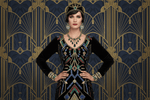
Art Deco Jewelry: A FAQ Guide
24 min reading time
24 min reading time
Art Deco jewelry is easy to recognize but harder to fully explain. We know its sharp geometry, repeating patterns, dramatic contrasts, and confident symmetry. What makes the style truly interesting, however, is not only what it looks like. It is what those forms reveal about the world in which Art Deco developed.
The movement emerged during a period of rapid change. Cities were growing upward. Machines, automobiles, ocean liners, and air travel were altering the experience of speed and distance. Fashion was becoming less restrictive. Artists were experimenting with abstraction, color, and form. Ideas and visual traditions were moving across borders—although the cultures that inspired European and American designers were not always acknowledged equally.
Art Deco brought those forces together. It translated the energy of modern life into objects people could wear.
Art Deco jewelry is associated most strongly with the 1920s and 1930s, although the movement’s roots appeared before World War I. Its later name derives from the 1925 Exposition Internationale des Arts Décoratifs et Industriels Modernes in Paris, an exhibition devoted to modern decorative arts.
Rather than describing one rigid formula, Art Deco encompasses a family of approaches. Some pieces are strongly geometric and architectural. Others retain stylized flowers, leaves, fans, and figurative motifs. Some use restrained black-and-white contrasts; others combine coral, jade, lapis lazuli, enamel, or colored gemstones with striking intensity.
What unites them is a sense of intention. Lines are controlled. Shapes are arranged for effect. Ornament is not scattered randomly—it is organized into a visual structure.
It is tempting to tell jewelry history as a straight line: Art Nouveau came first, Art Deco replaced it, and modernism followed. Design rarely evolves so neatly.
Art Deco emerged from several overlapping movements and conditions. It inherited respect for craftsmanship from Arts and Crafts; stylized nature and expressive line from Art Nouveau; technical refinement from Edwardian jewelry; geometric experimentation from Cubism and the Vienna Secession; and a fascination with modern materials, architecture, transportation, fashion, and urban life.

Art Nouveau jewelry celebrated sinuous lines, asymmetry, flowers, insects, feminine figures, and the sense that a design was growing or moving organically. Materials were often chosen for color and artistic effect rather than value alone. Enamel, horn, glass, and semiprecious stones could be as important as diamonds.
Art Deco did not abandon artistry or nature, but it disciplined them differently. Curves became more controlled. Flowers were simplified into patterns. Symmetry became more prominent. Architectural forms, repeated elements, and strong borders gave jewelry a clearer visual framework.
The difference can be understood as two responses to modernity:
| Art Nouveau | Art Deco |
|---|---|
| Flowing and organic | Structured and geometric |
| Often asymmetrical | Often symmetrical |
| Nature appears alive and unfolding | Nature is stylized into pattern |
| Emphasis on sensual line | Emphasis on contrast and composition |
| Handcraft as an alternative to industrialization | Craftsmanship combined with fascination for modern life |
Neither movement is more artistic or more modern than the other. They simply translate beauty through different visual languages.
Art Deco was not confined to jewelry. It appeared in buildings, furniture, fashion, posters, household objects, cinemas, trains, and ocean liners. That breadth matters because designers were responding to the same visual environment.
Skyscraper setbacks became stepped forms. Radiating architectural ornament became the sunburst. Repeated windows and structural grids became rows of stones or articulated bracelet links. Arches, towers, fans, and ziggurat-like silhouettes moved easily from buildings to brooches, pendants, earrings, and rings.

The machine age contributed more than new materials. It introduced a new visual rhythm: repetition, polished surfaces, precise alignment, and forms that seemed built for motion.
Jewelry designers adopted linear arrangements, interlocking components, and streamlined silhouettes. Even pieces made entirely by hand could convey mechanical precision. In the 1930s, curved edges and smoother forms became increasingly visible through Streamline Moderne, a related development within the broader Art Deco world.
Jewelry changed with clothing and hairstyles. Shorter hair created new space for dramatic earrings. Sleeveless dresses brought attention to the wrist and upper arm. Long necklaces complemented straighter silhouettes, while brooches, clips, and dress ornaments could be repositioned and worn in different ways.
Jazz, cinema, nightlife, and expanding consumer culture also helped associate Art Deco with glamour. Yet the style was not limited to evening jewelry. Its clean lines and adaptable geometry eventually made it equally at home in everyday design.
Art Deco designers drew from a wide range of visual sources. Archaeological discoveries—particularly the 1922 discovery of Tutankhamun’s tomb—intensified Western interest in ancient Egyptian forms. Designers also adapted motifs, techniques, and materials associated with East Asia, South Asia, Africa, Persia, and the ancient Americas.
These encounters widened the movement’s visual vocabulary, but they should not be romanticized as uncomplicated “cross-pollination.” European and American designers often worked within colonial systems and borrowed from cultures whose makers and meanings received little recognition. Understanding that context does not diminish Art Deco’s beauty; it gives us a more complete account of how its visual world was constructed.

Visual Language
Art Deco shapes do not carry fixed, universal meanings. A fan does not always “mean” glamour, and a sunburst does not always “mean” optimism. But forms create impressions, and those impressions help explain why the style feels so distinctive.
No single shape proves that a piece is Art Deco. Look for several cues working together: geometry, repetition, proportion, contrast, and construction.
Common features include:
Platinum and white gold became closely associated with high-style Art Deco jewelry because their strength allowed stones to be set in fine, intricate arrangements. Diamonds were often paired with black onyx to create sharp contrast. Baguette, emerald, Asscher, and other geometric cuts reinforced the architectural character of a piece.
But Art Deco was never only black, white, platinum, and diamonds. Designers also used coral, jade, lapis lazuli, emeralds, rubies, sapphires, enamel, glass, silver, and other materials. Color could be vivid, unexpected, and central to the composition.
 Gold, coral, and jade bracelet, 1925, Musée des Arts Décoratifs, Paris. Photograph by SiefkinDR, CC BY-SA 4.0.
The bracelet above is a useful reminder that genuine Art Deco was more varied than the monochromatic version often reproduced today. Its strong organization is unmistakable, but color and material give it warmth and cultural complexity.
Art Deco feels remarkably current more than a century after its development. Its geometry provides clarity; its ornament provides personality. It can be restrained and bold at the same time.
Many period pieces demonstrate extraordinary stone setting, articulation, proportion, and finish. That level of execution continues to appeal to people who see jewelry as both adornment and applied art.
Clean lines work naturally with modern clothing. A geometric bracelet, architectural earring, or structured pendant can complement denim and a white shirt, a tailored suit, or an evening dress without feeling like a costume.
Art Deco carries associations with jazz, cinema, travel, urban nightlife, and belief in technological progress. Those associations give the jewelry an emotional dimension beyond its materials.
Contemporary artisans continue to explore geometry, repetition, balance, contrast, and stylized natural forms. Some consciously reference Art Deco; others arrive at a similar visual energy through their own materials, traditions, and design perspectives.
The distinction matters. A modern geometric piece can carry Art Deco resonance without being a reproduction—or without its maker claiming Art Deco as the direct source.
Look for several characteristics working together:
White metals are common in original Art Deco fine jewelry, but they are not required for a contemporary interpretation. Today’s artisans may express the same principles in sterling silver, brass, mixed metals, beads, glass, or colorful gemstones.
The terms should not be used interchangeably.
An authentic Art Deco piece was made during the historical period, primarily the 1920s and 1930s. A revival piece was made later in a deliberate return to the style. A contemporary Art Deco–inspired piece uses elements of the movement’s visual language while being clearly identified as modern.
Age should be established through provenance, maker’s marks, construction, materials, and expert evaluation—not appearance alone. Geometry by itself does not establish authenticity.
At Sundara Joon, the connection to Art Deco is not based on reproducing vintage period jewelry. It comes from shared design values:
 This artisan-created chainlink bracelet uses repetition, geometry, and balanced structure to create an Art Deco feeling without presenting itself as a historical reproduction. View the bracelet.
Some Sundara Joon pieces reflect the Art Deco aesthetic directly; others share its confidence, craftsmanship, or clarity of form. The larger connection lies in jewelry with a point of view—pieces that bring artistic intention into what we choose to wear.
Art Deco’s roots appeared before World War I, but the style flourished internationally during the 1920s and 1930s. In jewelry, those decades are the primary period associated with authentic Art Deco pieces.
Art Nouveau favors flowing lines, asymmetry, natural forms, and a sense of organic movement. Art Deco tends toward stronger geometry, symmetry, contrast, and architectural organization. The movements overlap, and Art Deco retained some of Art Nouveau’s craftsmanship and stylized nature.
No. Platinum, diamonds, and black onyx became iconic combinations, but period designers also used gold, silver, coral, jade, lapis lazuli, colored gemstones, enamel, horn, and glass. Contemporary Art Deco–inspired jewelry can interpret the aesthetic through an even wider range of materials.
No. Geometry appears in jewelry traditions across cultures and centuries. An Art Deco association becomes stronger when geometry is combined with features such as symmetry, repetition, stepped forms, dramatic contrast, architectural composition, and materials or construction associated with the period.
Yes. Its clean lines make it unusually versatile. A structured bracelet, geometric pendant, or fan-shaped earring can add definition to everyday clothing without requiring a formal occasion.
Sundara Joon offers contemporary, artisan-created jewelry rather than representing the collection as vintage Art Deco. Pieces are included because their geometry, balance, contrast, or architectural character resonates with the movement’s design language. This framing can continue to accommodate future artisans while keeping the distinction between period and inspired jewelry clear.


