
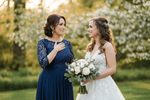
Jewelry for the Mothers of the Bride and Groom
23 min reading time
23 min reading time
Weddings mark a transition for an entire family. For the mother of the bride or the mother of the groom, jewelry can do more than complete an outfit. It can reflect personal style, honor family or cultural traditions, and become a lasting reminder of the day.
The best choice is not necessarily the most formal or expensive piece. It is the jewelry that feels true to the woman wearing it, works comfortably with her clothing, and carries meaning beyond a single celebration.

There is no single way a mother of the bride or groom should look. One woman may feel most herself in pearls and a tailored dress. Another may prefer a sculptural silver earring, a vivid gemstone necklace, or a handcrafted cuff.
Nor does one mother need to dress more quietly than the other. The goal is not to create a hierarchy. It is to let each woman express her individuality while respecting the tone of the celebration.
Before choosing a piece, ask:

Across many periods and places, jewelry worn at weddings has communicated family identity, prosperity, affection, faith, status, or hopes for the future. The specific meaning has never been universal. A pearl, jade carving, coral bead, or gold bangle can carry very different associations depending on its culture, era, maker, and wearer.
In nineteenth-century Europe and North America, for example, pearls and seed-pearl ornaments became closely associated with sentiment, purity, and bridal dress. In China, jade has held layered associations with virtue, refinement, protection, and enduring value. In South Asia and the Mediterranean, particular materials and forms have entered wedding traditions through distinct regional histories.
The useful lesson is not that every mother must wear a prescribed symbol. It is that wedding jewelry has long helped people make relationships and transitions visible. A contemporary piece can continue that tradition while remaining personal.
Jewelry should relate to the clothing without disappearing into it or fighting for attention.
| Dress or styling choice | Jewelry approach | Why it works |
|---|---|---|
| High, bateau, or jewel neckline | Earrings and a bracelet or cuff | Keeps the neckline uncluttered and draws attention toward the face and hands |
| V-neck, scoop, or open neckline | Pendant, collar, or short necklace | Echoes or fills the open space without overwhelming it |
| Heavily embellished or patterned dress | Refined metalwork or one restrained gemstone | Allows the fabric to remain the visual focus |
| Minimal or monochromatic dress | Sculptural earrings, an expressive necklace, or a strong cuff | Adds shape, texture, and personality |
| Hair worn up | Drop, hoop, or statement earrings | Makes the earring silhouette visible in person and in photographs |
| Hair worn down | Luminous or slightly larger earrings with secure, snag-resistant forms | Prevents the jewelry from disappearing while reducing tangling |
| Daytime or outdoor wedding | Organic textures, softer sheen, and natural color | Feels at ease in natural light and less formal settings |
| Evening or black-tie wedding | Pearls, polished metal, saturated gemstones, or controlled sparkle | Holds its presence in formal dress and lower light |

Pearls have carried many meanings across history, including wealth, refinement, purity, sentiment, and good fortune. Their associations depend on context, but their quiet luminosity has made them especially enduring in ceremonial and milestone jewelry.
The modern pearl does not have to mean a perfectly matched strand. Baroque shapes, asymmetry, mixed metals, and sculptural settings can retain the pearl's grace while feeling fresh and individual.

Pearls are particularly effective when the wearer wants softness near the face, a connection to family tradition, or jewelry that will remain useful after the wedding.
Gemstones can add color to a wedding look while carrying a story. Their meanings should be described with care. No stone has one fixed or universal message, and symbolic associations often change across cultures and centuries.
| Material | Selected historical and cultural associations | A thoughtful way to choose it today |
|---|---|---|
| Jade | In China, jade has long been associated with virtue, purity, refinement, and enduring value. Jade also held sacred and elite significance in several Mesoamerican cultures. | Choose it for a family connection, admiration for its history, its tactile beauty, or a personally meaningful color. |
| Moonstone | Its shifting light has encouraged lunar associations. Hindu traditions have linked it with moonlight and sacred stories. | Let its glow suggest transition, reflection, or a new chapter without treating those ideas as universal doctrine. |
| Lapis lazuli | Prized in ancient Mesopotamia, Iran, Egypt, and later societies for its intense blue, lapis appeared in elite, devotional, and talismanic objects. | Use its saturated color to bring depth and quiet authority to a neutral or metallic look. |
| Carnelian | Carnelian has a long history in seals, beads, rings, and devotional objects, including significant uses in Islamic and Mughal material culture. | Choose it for warmth, historical resonance, or a vivid accent rather than assigning it a single global meaning. |
| Coral | Coral has been treated as protective in some Mediterranean and European traditions and valued in many other regions. Because it is an organic material, age and sourcing matter. | Consider vintage, responsibly sourced, or coral-colored alternatives, and ask what is known about the material. |
| Rose quartz | Modern popular culture commonly associates its soft pink color with affection and compassion, although such meanings are not universal or timeless. | Select it because the color, emotional association, or family story feels personal to the wearer. |

A gemstone may be chosen to echo the wedding palette, honor a heritage, recall a loved one, or simply because the wearer feels beautiful in it. Personal meaning does not require an elaborate explanation.
The mothers of the couple do not need identical jewelry. Exact matching can flatten the individuality that makes each woman memorable. A subtler visual relationship usually feels more natural.
They might coordinate through one shared element:

For example, one mother might wear pearl earrings while the other chooses a pearl-accented necklace. One might wear a jade collar while the other wears earrings in a related green. The connection reads beautifully in photographs without making either woman feel costumed.

A piece can look perfect for ten minutes and feel impossible after three hours. Before the wedding, wear-test it with the dress and hairstyle.
Check the following:

The most polished choice is often the one the wearer can stop thinking about once the celebration begins.
Wedding attire does not require a complete matching set. One expressive piece often creates a more modern and confident result.

This approach keeps the look intentional and gives the chosen piece room to be seen.
The strongest wedding jewelry continues to live after the event. It can be worn to anniversaries, family dinners, graduations, or another wedding. With time, the memories attached to it may become as important as its material or design.
To help a piece become a keepsake:


Sundara Joon curates jewelry created by independent artists and artisan partners around the world. Many designs are one of a kind or made in small quantities, making them well suited to a moment that deserves something personal rather than predictable.
The collection includes modern pearl jewelry, gemstone necklaces, sculptural earrings, cuffs, and mixed-material designs. Some pieces carry a documented story of maker, place, or technique. In other cases, artisan privacy or the realities of small-scale production mean that not every detail is publicly shared. We believe in honoring the hands and creative traditions behind the work.
For mothers of the bride and groom, this creates an opportunity to choose jewelry that:
Jewelry With Story, Craft, and Intention
Jewelry for the mother of the bride or groom has no rigid rules. It is about recognizing her place in the story of the day while allowing her to remain fully herself.
Choose the piece that feels comfortable, considered, and alive with possibility. Years later, it may recall not only how she looked, but how it felt to witness a family changing and growing.


