

Agate - An Ancient Gemstone with Diverse Beauty
10 min reading time
10 min reading time
Agate is one of the earliest recognized gemstones to be used in jewelry and decorative arts. It is easy to see given its diverse colors and patterns. It is a worthy addition to any piece of jewelry both for beauty and hardness.
Discover Agate — a banded chalcedony cherished since antiquity. Learn about its formation, varieties, symbolism, cultural history, and care in this refined Sundara Joon gemstone guide.
“Agate is memory held in stone — each band a quiet echo of Earth’s unfolding story.”

Agate is a variety of chalcedony, which itself is a microcrystalline form of quartz.
What sets agate apart from other chalcedonies is its distinctive banding; layers of color formed over millions of years within the hollow spaces of volcanic or metamorphic rocks.
No two agates are alike. Their swirling patterns, concentric rings, scenic inclusions, and vibrant colors make each stone a miniature landscape.
Agate forms when silica-rich fluids deposit layer upon layer inside rock cavities.
Over time, these layers crystallize, creating:
This slow, natural artistry is why agate is often called a story stone.
Agate is abundant and global — found on every continent. Important sources include:
Each region produces its own visual signature of banding and color.

Used for seals, amulets, and protective talismans. Egyptians believed agate could ward off storms and grant strength.
Agate was carved into cameos, drinking vessels, and intaglios.
Ancient texts praised agate for:
Pliny the Elder wrote extensively of its varieties.
Agate (especially moss agate and banded varieties) symbolized:
Warriors carried agate arrowheads and beads for protection.

Semi-Circle Zig Zag Pendant Necklace
Agate rings engraved with meaningful inscriptions (often Quaraic versus) were believed to bring blessings and safeguard travelers.
Agate exploded in popularity due to Scottish jewelry traditions. Banded agates, moss agates, and montrose agates appeared in brooches, lockets, and mourning pieces.
Throughout history, agate has remained beloved as a stone of intelligence, balance, and protection.
Agate’s name reaches back more than 2,500 years and comes from a river in ancient Sicily.
The Greek philosopher Theophrastus, a student of Aristotle and the earliest known gemologist, described a beautifully banded stone he found along the banks of the river Achates around the 3rd–4th century BCE.
The stone became known as:
as a direct reference to its first recorded discovery site.
Later, as agate became widely traded across the Mediterranean and Near East, the name persisted, even though new sources were found on every continent.
Today the original river has been renamed the Dirillo River, but its ancient name continues to live on through one of the world’s most beloved gemstones.
A river gave agate its name, and the stone has carried that sense of flow, layering, and memory ever since.
| Agate Type | Color Pattern | Symbolism | Notable Sources |
|---|---|---|---|
| Banded Agate | Layered stripes in many colors | Balance, grounding, emotional stability | Brazil, India |
| Moss Agate | Green dendritic inclusions | Nature, growth, abundance | India, USA, Brazil |
| Botswana Agate | Fine bands in grey, pink, and brown | Comfort, emotional healing | Botswana |
| Blue Lace Agate | Pale blue with lacy bands | Calming communication, serenity | Namibia |
| Fire Agate | Brown with iridescent “fire” | Protection, creativity, courage | USA, Mexico |
| Tree Agate | White with forest-like inclusions | Peace, resilience, connection to land | India |
| Crazy Lace Agate | Colorful looping bands | Joy, vitality | Mexico |
| Dendritic Agate | Fern-like inclusions | Wisdom, reflection, grounding | India, Madagascar |
| Montana Agate | Smoky tones with plume inclusions | Strength, inner balance | USA (Montana) |
| Laguna Agate | Highly saturated bands | Passion, focus | Mexico |
| Turritella Agate | Fossilized shells within agate | Ancestry, deep memory | USA (Wyoming) |
Agate’s extraordinary variety is why it fits seamlessly into so many jewelry styles — bohemian, rustic, modern, minimalist, or statement-making.
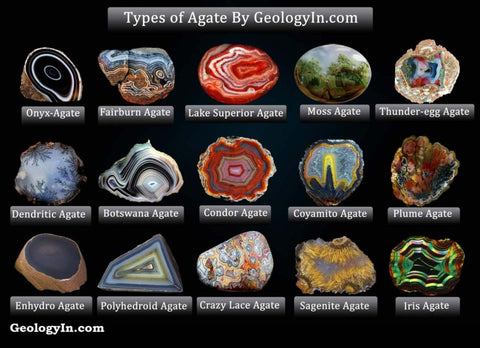 Chart courtesy of GeologyIn.com
It is important for collectors to know that while many agates show beautiful natural colors, the stunning uniform colors seen in most commercial banded agates (such as vivid blue, green, or bright red) are achieved through centuries-old, stable dyeing treatments. This process is standard practice, having been perfected by German cutters in Idar-Oberstein, and is what allows for such a vibrant, reliable palette in jewelry.
Yes. Agate ranks 7 on the Mohs scale, making it:
To maintain your agate's natural luster:
Agate is often associated with:
Historically, scholars, travelers, and artisans favored agate for its symbolism of focus, protection, and insight.
Metaphysically, agate is seen as a “slow-release” energy stone — steady, stabilizing, gentle.
Agate is recognized as a mystical birthstone for May and is also linked to Gemini and Virgo through modern zodiac traditions.

Designers appreciate agate because:
Agate offers both elegance and earthiness, making it a versatile gem for contemporary handcrafted jewelry.
Whether you appreciate agate for its scientific formation, historical significance, or striking aesthetic appeal, this gemstone offers something truly special for collectors and jewelry enthusiasts alike
From layered neutrals to vibrant colors, mossy greens to sky blues, agate celebrates the beauty of the natural world in every band and curve.
At Sundara Joon, our artisans use agate to create:

Each piece honors the stone’s ancient roots and contemporary charm.
✨ Explore our agate collection and find the pattern that speaks uniquely to you.
By supporting our artists, we contribute economically and provide essential business education, helping them thrive sustainably while producing exceptional work.
Still interested in learning more? Please check out these informative sites.


