

Worn with Intention - More about Rings
15 min reading time
15 min reading time
Rings are among the oldest forms of personal adornment worn by women. They may be relatively small in scale, but they can be big in meaning. Across centuries and civilizations, rings have served as symbols of power, identity, devotion, status, and self-expression. From ancient seals pressed into wax to modern sculptural statements worn purely for joy, women’s rings tell a story not just of fashion, but of culture itself.
A history of form, symbolism, and cultural meaning
Rings are among the oldest forms of personal adornment worn by women. They may be relatively small in scale, but they can be big in meaning. Across centuries and civilizations, rings have served as symbols of power, identity, devotion, status, and self-expression. From ancient seals pressed into wax to modern sculptural statements worn purely for joy, women’s rings tell a story not just of fashion, but of culture itself.
What follows is a guide to the most enduring types of women’s rings, tracing their origins, symbolism, and how they continue to evolve today.
The tradition of ring-based commitment dates back over 4,000 years to ancient Egypt, where circular bands symbolized eternity. Romans later formalized the practice, associating rings with legal contracts and marital ownership, often worn on the fourth finger of the left hand, because it was believed to contain the vena amoris, or “vein of love.” Across cultures:
India: Wedding rings coexist with toe rings (bichiya) symbolizing marital status.
Europe: Engagement rings gained prominence in the Middle Ages, often engraved or set with symbolic stones.
Modern era: Rings reflect individuality; colored gemstones, asymmetry, heirloom resets, and ethical sourcing now rival tradition for selection choices.
Today, these rings represent partnership, choice, and shared values rather than ownership.
Signet rings originated in Mesopotamia and ancient Rome as tools of authentication; pressed into wax or clay to seal documents. Historically worn by men of power, women also used signets, particularly those in royal and aristocratic lineages.For women, signet rings have symbolized:
In modern fashion, women’s signet rings are worn as statements of self. They can be engraved with initials, symbols, or left deliberately blank to suggest an identity in flux, or one that is still to be determined.
Cocktail rings rose to prominence during the 1920s Prohibition era in the U.S. Worn by women attending underground parties, these oversized, gemstone laden rings were conspicuous by design, they symbolized of rebellion, glamour, and autonomy.
Today, statement rings continue this legacy. They mark personal milestones, creative flair, or simply the joy of adornment - no permission required. They are fun, pure and simple.

A quiet language of intention, culture, and self-expression
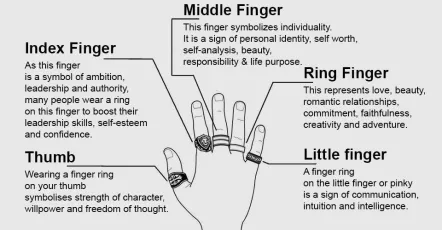
Beyond the design of a ring itself, where it is worn has long carried symbolic meaning. Across cultures and centuries, finger placement has conveyed everything from marital status and authority to creativity, independence, and personal intention. While modern women are free to wear rings however they choose, many still appreciate the subtle language behind each finger.
At Sundara Joon, this philosophy aligns naturally with how rings are designed: worn with intention, layered intuitively, and adapted to the wearer’s life rather than rigid tradition.
Wearing a ring on the thumb is traditionally associated with independence, strength, and self-direction. Historically, thumb rings symbolized power or authority, particularly in Asian and European cultures. Today, women often choose thumb rings to express confidence, individuality, and a non-traditional approach to jewelry.
The index finger is linked to leadership, ambition, and identity. Historically, signet rings were worn on this finger to represent authority and family lineage. In modern wear, index-finger rings often symbolize intention, purpose, and personal confidence.
The middle finger represents balance, responsibility, and self-reflection. As the central finger, it is often chosen for statement rings that feel grounded and intentional. Many women wear bold or meaningful rings here to symbolize inner strength and boundaries.
While traditionally associated with marriage and commitment, the ring finger today also represents personal vows, milestones, and emotional significance. Many women wear gemstone rings on this finger to mark achievements, life transitions, or commitments to themselves rather than to tradition.

Floral Inspired Gemstone Rings
Pinky rings are associated with communication, intuition, creativity, and independence. Historically worn as fashion statements or family rings, pinky rings today often signal individuality, artistic expression, and quiet confidence. Or, in the case of one of our customers, she loved one of our rings but it was too small for her other fingers so she elected to wear it on her pinky.
Cultural traditions vary. In some countries, commitment rings are worn on the right hand; in others, the left. In modern styling, many women choose hands based on comfort, balance, or personal meaning rather than strict convention.
The best choice is intuitive. Consider:
Ultimately, the meaning comes from why you wear the ring; not just where.
Sundara Joon rings are not designed for a single role or rule. They are meant to move with the wearer—across fingers, across phases of life, across cultures. This flexibility reflects a modern truth: meaning is personal, and jewelry should adapt to the woman, not the other way around.
For Women Who Choose Their Own Symbols
Sundara Joon rings are often chosen:

Whether you’re drawn to a particular gemstone, shape, or story, each ring offers a quiet sense of significance—something felt as much as seen.
Are Sundara Joon rings one of a kind?
Many of our rings are one-of-a-kind or produced in very small micro-lots, making each piece uniquely yours.
Are the gemstones natural?
Yes. Our artists work with natural gemstones selected for quality, character, and design significance. This is one of the reasons we work with artists in SE Asia and particular Thailand, the gemstone market is in their backyard and they have ready access to a variety of beautiful stones to spark their imagination.
Can these rings be worn every day?
Absolutely. Many of our designs are intended for daily wear, though we always recommend removing rings during heavy manual activity. Please note that depending on the material such as gemstones, some are more delicate than others in terms of hardness. Also some stones may be more sensitive to heat and water. We've written articles on the stones and linked them to the product profiles so you can see for yourself if any special care is required.
Do you offer ethical or artisan-made rings?
Yes. Ethical sourcing and artist partnerships are core to Sundara Joon’s mission.
A ring is the most intimate piece of jewelry you wear—it moves with your hands, your work, your life. Sundara Joon rings are created for women who see jewelry not as decoration, but as personal narrative, its a visual image of what appeals to you and makes you the individual you are.
Explore the collection and find the ring that feels like it was waiting for you.
Sundara Joon curates small-batch, artisan-made jewelry, gifts, and collectables, including fabric art, textiles, and functional objects from global makers. Each piece is chosen for its craftsmanship, story, and enduring beauty
#handcrafted artisan jewelry artisan rings artisans handcrafted artisan jewelry handcrafted jewelry handcrafted womens rings jewelry worn intentionally sundara joon jewelry sundarajoon jewelry


Discover the global stories, materials, and traditions that shape our collections. Read our stories in Crafted with Intention »
